Category Archives: Uncategorized

Multipotentiality

I listen to books or podcasts while I’m getting ready in the morning to keep myself from thinking too much and getting wound up about all the “what might happens” each day.  Some parts of the year are rougher than others, and the days leading into holiday breaks are often more difficult than others.  Lately, I’ve been re-listening to Brené Brown’s new book, Daring to Lead.  It’s my fifth or sixth time listening, and I still hear nuggets that get me thinking that are different from the nuggets that made me think the first time.

Something she said this morning was about honoring the strengths of the people you work with, creating opportunities for them to showcase their strengths.  I had a momentary self-thought, “Clearly, I have lots of strengths otherwise I wouldn’t be involved in so many damn projects…”  (Overwhelm this time of year is real, folks.)  And this got me thinking about the idea of multipotentiality in our gifted kids.

Multipotentiality is essentially having many strengths which lead to many options.  It’s great to have options, right? For our gifted kids, though, having a multitude of options available to them, particularly when they’re in high school or college and beginning to think about what careers they want to have, makes it very difficult to decide.

I’m a pretty good artist; maybe I could go into graphic design.

I’m a good writer; maybe journalism is the right way to go.

I’m good at math and I enjoy it; perhaps engineering might be a better choice…

I could also go into medicine; I enjoy research, biology, and chemistry.  I would really be able to make a difference someday.

My heart is in the theater though…what about pursuing acting? Or music…I play four instruments well…perhaps an orchestra?

I love to learn too; maybe I should go for a graduate degree instead before I decide.  But what should be my focus?

Hrm…I’m enjoying learning about politics and being active in my community; maybe I should spend a year or two working with a campaign to learn more.

I was named player of the year in soccer this year though, and I’ve grown a lot.  I could look into playing for a college and then maybe coaching…I’d get to be with kids and help them learn to love the sport that I enjoy so much.

Gifted kids struggle with this earlier and earlier, as the pressure mounts for them to make decisions about their future at earlier and earlier ages.  Parents see potential in their kids, and want what’s best, and so they arrange for summer camps around their passions or strength areas and fix opportunities for their children to work with those doing the work their kids are interested in at the college level or professionally.

I remember asking one of my girls one year what she wanted to be when she grew up.  She rattled off a list of 20 careers, all of which she’d surely excel in, each honoring a piece of who she is and the difference she wanted to be in the world.  I loved that she wanted to do so many things with her life, so many of them were selfless and for the benefit of others which was a testament to her beautiful heart.

She’ll go off to high school soon, and asked for advice about which high school she should choose.

I remember a time when your parents made that decision for you.  You didn’t get a say.  It was the big building down the street where all the neighborhood kids went or your mother or father’s alma mater or preference if private school was affordable.  And it wasn’t anything like choosing a college…it was a place for you to go to finish your basic education before you determined where you would go to focus on career creation.  I observed families and kids during our high school night this past week, interviewing schools for what they have to offer our gifted kids, and noted that parents were overwhelmed (how are they old enough to be going to high school??) and kids were either ambivalent or excited at the prospect of getting to choose their high school, taking it seriously–who will meet my needs?

There’s a pressure there these days that hasn’t always been so prominent.  Adults expect children to decide early what they want to do with their lives so that they can get on the right track to that career and be successful. Many gifted kids, however, rebel against this, drifting between majors and minors, spending eons in college trying to determine what they’ll feel fulfilled by doing.  After graduation they drift from job to job, searching for something that meets the needs of both their own intellect and areas of passion as well as the societal requirement that they be gainfully employed, having chosen a spot and stayed there.  In the past, most were looking for a job after college, not necessarily a career…many of those happened by accident because you stayed in one job for a long time.

I look through my to-do list every day, multiple times, and the myriad categories it holds, finding myself switching hats minute to minute to ensure that everything gets done.  I don’t have a day to do X, another for tasks related to Y, and third for those that are for the benefit of Z…they all run together, overlapping, confusing things because there’s no clear delineation between which master they serve.  Multipotentiality can be stressful…and the need for a larger hat rack is real.

Our kids are entering a world where they will hold jobs that haven’t even been imagined yet.  How do we support them when their strengths and passions can go in so many varied directions, while still honoring that each one is a piece of the whole they are?


 

Education Conference Season Beginneth

There are two times of the year when education conferences seem to be plentiful.  October/November, and February.  Snow is quite possible, particularly for those in February, and sometimes it feels like they all happen at once…soon as one is done, the next pops up and you’re off again.

I had the opportunity to speak at two conferences this week: the CAGT (Colorado Association for Gifted and Talented) Conference and for a mini-conference for PPIRA (a local chapter of CCIRA, which is a wonderful organization that supports literacy in our state).

The audiences couldn’t have been more different, and though I’d presented the same information this summer at ComicCon (SQUEE!!! REMEMBER THAT?), the audience and purpose for each session this week was much different than the first so I did some revision and editing, and refined it for time, in particular, whittling it down to just under an hour.

I’d had a full day of sessions on Monday at CAGT, from which I had jotted down a thousand notes, everything from ideas discussed on the drive up and over meals with colleagues to golden nuggets of information shared by other brilliant minds that I wanted to be sure to touch on, not only to ensure that those who said them first got credit and that those ideas got reiterated, but to demonstrate what the mind of a teacher does at an education conference–we steal ideas for ourselves and use them later with our own students.  My students are just a little older now…

I sat with my veggie burger, sweet potato tots, and a cider (#selfcare #healthyeating) at the desk in our hotel room Monday night, with whatever was on BBC and began tweaking again.

I’d listened to Temple Grandin speak that morning and she always shares wording that is helpful–we need all kinds of minds.

Image result for Calling All Minds: How to Think and Create Like an Inventor
templegrandin.com

I’d listened to ideas from Mark Hess (https://www.giftedlearners.org/), Patty Gaddo Walden (Her Website), and Jenny Hecht (Karuna Healing) as they spoke about understanding the needs of our gifted kids that go beyond academics…and the needs we as gifted adults have as well.  My notes were a mess, but my “To Do list” marks were clear.  I was up a long while editing and running through everything again, just like I did on Sunday afternoons when I taught in a classroom and made my notebooks for the week…

When it was my turn to present on Tuesday I felt pretty good but worried that few would come.  Pop culture isn’t exactly traditional academics.  I’d overheard teachers and GRTs discussing sessions their administrators were requiring they go to, and I worried that admin requirements and the innate sense of obligation would win.

I’d set up early and sat in the back of the room with a cup of hot chocolate to run through things one last time.  People trickled in, left their things and went to snag coffee and snacks, or buy books to take home.  Some reconsidered and left altogether.  A few familiar faces sat down, some willing to do so in the front.  (Even if they’d come just for moral support, it was so appreciated.) Suddenly, the room was full, and some were standing in the back, others parked at the sides where the tech could be plugged in.

I won’t run through the whole presentation, but I will say that there’s a reason I loved teaching kids.  You can tell immediately how what you are sharing goes over…kids have no filter and their non-verbal messages are VERY clear.  Gifted adults are pretty similar.  Grins and nods, furious notetaking, giggles and sidebars with colleagues while pointing…they got it.  The room as a whole vibrated with excitement and a sense of possibility.

As I packed up, I was giddy.  It had gone well.  People left chatting about their thinking and were considering ideas.  And they understood a piece of the kids we serve every day a bit better.  And maybe someone will take something I shared and tweak it to meet the needs of some kids they serve this week…putting the pieces of these kids together to help them access content and know that someone really sees them.

Saturday, I presented the same session again, twice, to a very different audience.  PPIRA’s mini-conference was called “Special Populations.”  I’d helped put the conference together and we had some really wonderful speakers, people doing the work with kids out there in local schools.  I’d always come away from the conference with ideas when I’d come as a participant, and I hoped that those attending would as well.  We’d worked hard to market it and felt that we had valuable expertise to share.

Again, the worry was there that I’d have few participants simply because the needs of gifted kids aren’t discussed at conferences very often unless they’re conferences ABOUT gifted learners.  Some classroom teachers say that the needs of their struggling students are their biggest concern–the gifted ones will have to wait.

I was pleased to see that the signup sheets were mostly full and as people filed into the room, that same excitement I’d had on Tuesday returned.  Initially, the non-verbal feedback was different with crossed arms and thinking faces. Gradually though, some of the grins and furious notetaking came through.  The second session was similar, and feedback I received from people as I packed up and we made our way back to the main room was positive.  Again, ideas to take home and share, a few things to try, and intentional thoughts on how whole teams might incorporate pop culture references into their teaching.

I left exhausted and drained, but happy.  I’m an introvert, and while I get energy from an audience while I’m speaking, once I’m not speaking and the audience has left, I am like a car on a long, flat road between towns with no gas station in sight.

I read through the survey feedback from Saturday’s conference this morning and it was overall very positive.  Teachers liked the diversity of topics, enjoyed the speakers, and for the most part, had left with a little inspiration from one or more of us, and had good suggestions for next year.  A few noted they’d be willing to present.  There were some specific positive comments about my presentation and those of the colleagues I work with who also presented for us, but one comment stood out in the question about what they’d like to see topic-wise next year:

More gifted.

Someone got it.


National Day on Writing, October 20, 2018

Today marks the National Day on Writing.

For me, writing is something that almost always came fairly easily and I’ve always enjoyed it.  I dabbled in poetry, attempted to be a news reporter and music reviewer, wrote more business proposals and letters than I can count, and still find myself writing opinion and reflection pieces fairly often.  The challenge for me came when teachers began to require outlines to be submitted prior to submitting a rough draft of an assignment.  I had to research and write the entirety of the paper before I could create the required outline–that’s just how my brain works.  I was usually willing to take their thoughts and go back and revise my work (that they hadn’t yet seen) based on their suggestions and then turn in that as my rough draft.  I recall lots of red pen, lots of criticism, both useful and not, and lots of revision.  But I knew all along I was a real writer.

Looking back on my years in the classroom, writing was often a pain point for my students and I.  When I first began teaching, I’d had no formal training in how to teach writing, and found it really difficult to explain “how to write” to kids who had focused mostly on reading skills until they reached the fifth grade, so I found Step Up to Writing and The Write Tools trainings and tried the things those programs suggested.  It was helpful, but I still felt something was missing and I was teaching kids to write to prompts, using formulaic patterns, and wasn’t able to just let them write, teaching universal writing skills.

After I moved to a new school, a colleague gave me words for what I’d been thinking all along.  We are growing writers, not producers of writing assignments.

There’s a recipe for growing writers,  you see.

Provide instruction in a way that allows them to explore all the different genres of writing and understand the purpose of each.  This includes everything from narrative to poetry, a variety of informational writing that includes the kind that requires sources be used and quoted, opinion and argument writing, business and friendly letter writing, email writing, and even prompt-based writing, because it is a part of getting into training programs and college and even obtaining gainful employment.  Kids should experience all of it…

Help them determine who their audience is, and then decide what genre of writing will communicate their ideas best.

Support them while they’re learning the rules of communicating in writing: how to hook a reader, how to structure and elaborate on their ideas, how to end in a way that makes the reader think a bit, and how to use grammar and conventions in ways that strengthen their ideas, not detract from it.

Give them choices in content, process, and product.  Writers flourish when they have the opportunity to make choices about how they will share their ideas.

And when they get stuck, because they will very often, share strategies that actual writers use to move beyond the stuck.  Do they need someone to help and ask the right questions to help them explore their thinking a bit more?  Someone or something to help them get ideas out to start with?  Would tech support help? Would taking a break for a while help?  Writers don’t exist on an island…they have supports in many forms available to help them when they’re stuck.

So many of our gifted children struggle with writing and it hurts my heart to hear teachers demand that students write only to prompts, only write shared ideas, and only write in the assigned genre or format.  It tears at my heart when I hear teachers say that writing isn’t important anymore because collaboration has taken hold, and discussion is more critical a skill.  And my heart breaks when young teachers whose focus in school was in other areas give up on learning to be a teacher of writing because it’s hard, choosing to not pursue professional development in their own area of need because they are afraid of it…and afraid of failure.

A friend of mine has a saying: “We can do the hard things.”  And for many, including our gifted kids, writing falls into the “hard things” category.  We need to grow writers.  In a world full of social media and the anonymity that the internet provides, accusations of fake news, and a serious decline in honest-to-god reading among all age groups, it’s never been a more critical time to grow our writers.

Who will document our future history?

Who will explore our cultural experiences?

Who will create new worlds that exist best between the pages of a novel?

Who will write the poetry that will lift hearts, spill tears, and explore the human experience?

Who will write on behalf of those less fortunate, those in struggle, those experiencing war and poverty?

Who will write the speech that calls for a revolution?

Who will keep the diary that impacts generations after they’re gone?

It’s late, but not too late to find the writer inside yourself.  Use the back of an envelope if you must, but write.  Write something every day.  Model what it is to be a writer for the kids in your world.  We’re real writers.  They are too.

Burnout

This week I’ve seen countless articles and had several conversations with colleagues and friends about burnout. Burnout isn’t some imaginary affliction and many professions experience it, but right now, the media is talking about how it impacts teachers and thereby our students.

In my parents’ day, you went to work every day at a specified time, did your job, came home around 5 (without work to do) and brought home a paycheck every two weeks that equated your time with a set monetary amount.  There was never discussion of whether or not you loved, much less LIKED, your job.  You did the job as a means to an end…survival.  In years past, teachers kind of followed that same formula–go to work, work, go home, collect paycheck.  They’ve always had a few other things added in though: taking student work to be home to be graded, arrange for professional development to ensure their licenses would renew and they could keep their jobs, follow up with parents about student progress, prepare materials for class, teach after-school enrichment, coach, or work second jobs (or all of those things).

There’s a meme floating around that says something along the lines of teaching being the most important job in the world and the hardest because it’s the most important job every day.  Kids rely on teachers to help them learn, help them develop into good humans, help them learn to handle conflicts, learn to play, and learn to do the work of learning.  Parents rely on teachers to take care of their kids for the 7 hours they’re in class together, keeping them safe and engaged in the work of learning.  Administrators rely on teachers to keep up with paperwork and grading, engage parents and meet the needs of the children they are serving, assess student progress and be able to turn lessons on a dime to meet the needs of ALL the kids–those with special needs, those who are typical, and those who are gifted–all at the same time with the same instruction.  The public relies on teachers to create an educated populus to ensure that we are able to continue existing as a free nation…and some want religious beliefs (theirs only) taught daily in schools and others want that kept at home but reinforced at school and still others don’t want any of it anywhere.

Those are pretty high expectations.  And for every child, every parent, and every member of the public, what that looks like will vary–we will not be able to have what we do make all of them happy at the same time.

Then you throw in the needs of spouses, the needs of a teacher’s own children, aging parents and their needs, student loans and mortgage payments, car maintenance, college tuition for the aforementioned children, and general adulting.

And when you are a teacher of gifted children things are a bit more complicated in the classroom.  You’re working with the intensities of the children you serve as well as those of their parents, who have a distinct view of what their child’s school day should look like, sound like, and feel like, both for them and for their kids.  You’re mindful of how you pace your lessons (slower? faster?) and where depth and complexity comes into play in the activities you choose–you worry about how you plan and word your lessons, how you lead discussions of novels and current events articles, of scientific theories, of history as a whole, trying to figure out how to explain all of it without offending someone’s religious beliefs, political beliefs, cultural background, or general upbringing. Was the lesson rigorous enough?  Too difficult?  Developmentally appropriate? (because with asynchronous development, that changes depending on the topic…)  What I do for Jane in reading (her area of giftedness) has to change in math (an area of struggle) because while she’s gifted all the time, she isn’t as strong in all subject areas so what works in one won’t work in another…

You worry about how conflict between kids is handled–their intensities play a HUGE role in their conflicts.  It should be a learning experience for them, but how much of it needs to be just “handled” by you to send the message to parents that you’re doing your job the way they want your job done?  Will emotional and social needs of the kids be met if it’s a quick fix or does it need to be something more involved?  At what point do we step aside and support kids as they figure out how to exist with humans who may not share their thinking?  Does every moment of the day need to be teacher-led to ensure that no one feels uncomfortable or is teaching kids how to work through those feelings important?

You spend hours fielding questions and notes from families questioning why you are doing what you are doing and how you’re doing it because they feel strongly it should be done another way.  Their insight and feedback is valuable, but it’s draining…and you can’t change everything so that it’s the way one parent wants it because you’ll have four others who take issue with the fact that it wasn’t changed to the way they want to see it done.  So you go back to the research, the best practice…and risk more conflict.

Burnout is real.  And it’s common among teachers…and moreso among teachers of the gifted.

We consider whether working at Whole Foods is a better choice or really look at Tahiti as a living situation…

We come back every day because we recognize that what we do is important.  These kids, this particular population, needs us to be there for them, to advocate for them, to really SEE them.  We work hard to build relationships that are rooted in trust with our kids and their families.  We really are trying to do the best for kids in the long term.

I have a pin on the quilt that hangs in my office.  It says “Didn’t please everyone.”  (I think some days I’ll just wear it as a badge of honor.) We can’t please everyone.  And I think that knowing and really understanding that is critical to ease the potential for burnout.  What’s most important?

Are the kids you serve growing?  Are they having learning experiences that make them think, seek connections, and grow as humans?  Are their relationships with you and their peers growing and healthy?  Are you seeking out support when you need it?  Are YOU growing in your practice? Your knowledge of practice and content and kids? Do you take time to practice self-care?

IMG_7276

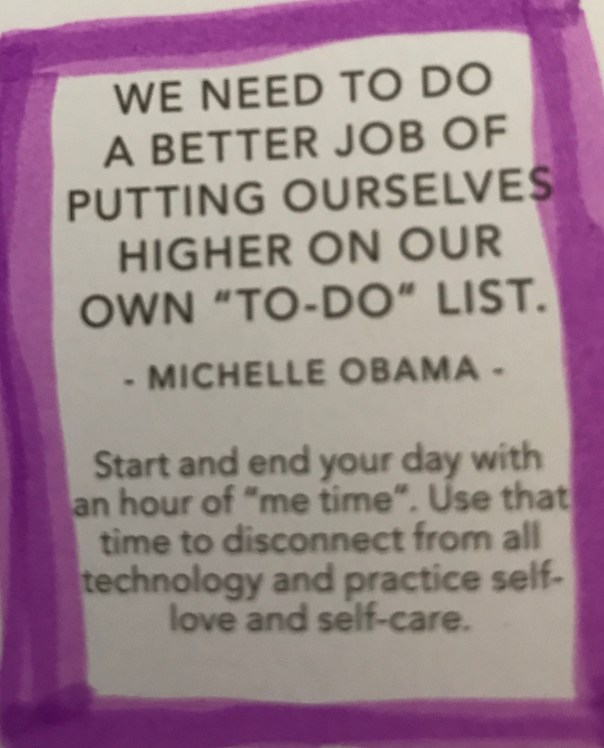
This was in my Passion Planner this week. Self-care is how we can work to overcome burnout.  What it looks like for all of us is different, but if, at the end of the day, we can look in the mirror and know that we tried something new, learned something new for ourselves, and made a difference to a child in some way, that’s a pretty good day.

The to-do list will be there…don’t forget to take time for you.


Differences…

Last week, I was able to share a day with educators north of here and present a session on Gifted 101…  I tailored it some to focus more on the social-emotional needs of gifted kids, but it was fairly basic information designed to help those without a background understand the gifted world a bit. Most were teachers in charter schools and were learning with a particular model’s framework in mind, and all of them wore multiple hats, to include that of gifted resource teacher or coordinator (the person doing the paperwork toward identification) for their building.  Some had gifted kids of their own, and others didn’t, coming primarily because they felt a need to learn more to be of more effective service in their buildings.

I was like that.  I left my second try at an undergraduate degree feeling incredibly unprepared, and so I kept going once I’d received my BA to complete a master’s degree hoping that might help.  It didn’t.  I still felt woefully unprepared to be a teacher.  I had kids in my classes I had no idea how to help and little to no support in learning how, including one who spoke absolutely no English and my limited Spanish wasn’t appropriate for 10-year-old years at all.  I spent lots of weekends and evenings in some sort of professional development during my first two years to learn more.  I picked up CDs at the library to listen to at home to learn about Love and Logic and listened over and over again so I was sure I’d get it right.  I bought every Kagan Cooperative Learning book I could get my hands on and took every training they offered through my district.  I asked for training in how to create math units that would please my administrators because it wasn’t an area of strength.  I enlisted colleagues who were better or more seasoned than I was in trying different strategies to reach the kids I was serving.  I reached out to district “experts” for support as well, and they were incredibly helpful, providing units already designed that included tiered activities to reach the wide variety of learners I was sharing my day with, those requiring introductory exposure and those requiring more challenge beyond grade-level.

When it comes to what information we receive in pre-service coursework relating to gifted students and supporting them, it’s different depending on the program but it’s rarely enough.

What gifted looks like in every building, traditional public school or charter, varies widely too, which complicates the idea of not knowing what you don’t know.  Some provide pull-out services so that students see a gifted teacher once or twice per week for a particular class or specific project support, and some buildings even have funding to support someone all week long, teaching small groups of identified or mostly-identified students.  Other buildings use push-in support, where the classroom teacher and gifted teacher co-teach, or the gifted teacher supports the gifted cohort in the classroom with more advanced, complex, or deeper levels of content.  Others have neither, relying solely on classroom teachers to use their powers of differentiation to meet the needs of the gifted students they serve, but perhaps having someone who handles paperwork and testing toward gifted identification while they teach other classes that may not be related to gifted needs altogether.

It’s interesting to have the opportunity to share what I’ve learned over the past 9 years with educators working with gifted students in such a wide range of experiences.  They had such wonderful questions, comments, and thoughts to share.  One of the things everyone in the room shared was a willingness to learn something new and think about how it might work in their individual buildings.  I enjoy listening to teachers brainstorm and share what they’ve done and what they’ve experienced with other teachers who are either just beginning this journey or feeling overwhelmed having had this hat added to their wardrobe this year.

We may come from different models of education, but all of us are in it to support kids and give them a quality education.


Human BE-ing

In education, we have a lot of buzzwords.  What “synergy” is to white collar industry, “self-care” is quickly becoming to education.

For a lot people outside of education, they go to work, work, and come home, commencing “life” upon clocking out at 5pm.  Work doesn’t often jump in the passenger seat beside them as they pull out of the parking lot and it rarely tags along for weekends or vacations.  Most people don’t check work email after hours or on weekends, nor do they spend their “off” time thinking of ways to improve business or engage more clients.  They rarely go in early to work or stay late beyond what they’re scheduled.  There’s no threat of losing their position because they left work on time or came in just in time for their shift to start.

Teaching is a little different.  And teaching tall poppies is another animal altogether, because the intensities of the kids and adults is often both beautiful and draining.  Setting boundaries for yourself is critical.

“Tonight, I will stay until 6pm and work solidly without interruption.”

(Telling colleagues your plan and emphasizing the lack of interruption is critical for this to work.)

I notice colleagues setting timers, locking doors and drawing blinds, hiding away in dimly lit classrooms to ensure that they can work, and enlisting spouses and significant others in the phone calls to remind them to come home because time’s up.  I notice their bags expanding rolling carts with full sets of writing and math journals as they sneak out later than they anticipated.  Others come in early, hiding out in classrooms hoping no one will notice their car in the lot.  And others choose to work at home, further blurring the line between work lives and home lives.

After a while, this begins to wear thin and “Why can’t I just go home at a reasonable hour?” begins to rear its head, screaming at the top of its lungs.  Resentment builds, and envy of those friends who can go home after an 8 hour day and enjoy frosty beverages on their porch with friends until 11pm without worry of what that will cost them the next day begins to grow. Guilt comes for tea and stays a while.  Am I being a good mother/father/wife/husband?  We begin to cling to our teacher friends and colleagues more–they get it.  And they know we’ve jammied up in the first 30 seconds of being at home before we’ve even fed the furs without jobs–they don’t ask us to do anything after work.  They know.  We begin doubting–is this really what I want my life to be?

This isn’t how things should be.

I’ve been a morning person my whole life.  My love wonders how on earth I can stay up late with him and then get up early to go to work and be remotely functional.  See, I get up before God is awake and I’m out the door before the sun is even considering its first cup of coffee.  The coffee kiosk down the street from school and I have an unspoken understanding after 9 years.  They start my drink about the time they figure I’ll show up (it’s almost always the same) and it’s done soon as I drive up–they can see me coming.  Large peppermint hot chocolate…every day.  It’s my reward for getting to school at an ungodly hour by choice.

I’ve spent 12 years doing this work and I’ve always come in early and stayed late.  And resentment creeps into my mind much faster every year.  I don’t like it.  It doesn’t suit me at all.  I love my job and the kids and adults I work with and when resentment shows up and parks a lawn chair down with an icy glare, I worry that the love I have for what I do will disappear.

I can conquer resentment.  I’m stronger.

Two weeks ago, I did something I haven’t done since I began teaching.

I took a day off to do something fun.

We bought concert tickets for 2 nights and decided to spend the weekend away, leaving early in the afternoon for the first night’s concert.

I didn’t take any work with me.  No computer, no bag of books, no emails.  I set my away message in my email days in advance so I wouldn’t forget.  The only thing that made the cut was my passion planner.  I wanted to be able to journal.  I brought only my purse and a weekender bag with weekendy stuff in it like flip-flops and distressed denim and tops with spaghetti straps.

Over a long weekend, I did it again.  I worked late Friday out of necessity, and closed the email tab before I had even left for the night…it was a reasonable hour–an hour at which most of the world had shut down their work day, knowing that it would wait until the next work day.  I didn’t do anything that could be construed as work all weekend.  I went to a football game and to lunch with a friend.  I bought paint and painted my bedroom and part of the hallway.  I made meatloaf and mashed potatoes with peas.  I lounged on the couch with a cat on my belly and watched hours of Britcoms.  I took myself to breakfast and planned my week in the quiet of a coffee shop.  I used a pen in my planner.  (ooh…teacher risks.)  I slept until I woke up…and then I napped twice before dinner because I could.

It felt good to just BE….to be a human BE-ing.

A part of me worried about the price I’d pay.

I adore my job and I truly love the people and kids I get to work with every day.  But I also love the way that spending a weekend away with my love feels–I’d seriously forgotten how that felt.  I enjoyed painting a room in the quiet of my home with no tv or Pandora or anything playing.  I enjoyed remembering who I am as a person with a particular job… The work I do is part of who I am, for sure…but it isn’t all I am.

I am a teacher, a coach, and technically admin.  I am a writer, a presenter, and an advocate for gifted kids.  I am a lover of Britcoms and cheesy documentaries about the possibility of alien life on Earth.  I am a woman who likes college football a few Saturdays a year, concerts where people stand and dance while they sing along, and consuming mass quantities of glorious fried Southern food made in tiny dive restaurants in strip malls with the person I love most in the world.  I am a lover of books of all kinds, 80s movies that star one or more members of the Brat Pack, and good music that speaks to my heart.  I’m a future wife and only daughter.  But most of all I’m a human BE-ing and I’m entitled to a little time to just be that.

So are you.  You give your whole heart and soul to your profession, to the kids you serve, to their families, and to your colleagues.  Don’t set aside your human BE-ing in favor of grading a paper for everything….25 times.  Set your boundaries.  Go home at a reasonable hour most of the time.  Honor the time you are in the building well and know that support doesn’t always look like “doing for.”  Sometimes it’s just telling where to find or who else might be able to help.  Honor your time and others will too.  This is our season of sacrifice, however it doesn’t have to be the only season we embrace.

Don’t forget there’s a reason we’re called human BE-ings.  Sometimes we just need to BE.


Home.

When I began teaching twelve years ago, there were a few in my first class who just didn’t quite fit in with the rest.  Most students were typical learners, several working well below grade level.  But a few…a few stood tall above the others.

  • A, the girl who was reading Jane Austen at 10 who chose to sit apart from everyone else and had such sad eyes…the eyes of an old soul who knew this was not her tribe but knew too that it existed…there were others like her, she just had to wait to find them.
  • C and his best friend (his name escapes me but his sweet little face and big brown eyes are so fresh in my mind) who only spoke Wookie for the first two weeks of school.  And I let them, inferring from their grunts and guttural sounds what it was they wanted.
  • W, who was shorter than everyone else and knew he was better at math than me and made a point of commenting on it every chance he got…and he got a lot of chances.  Some on purpose, and some because fifth-grade math was an area of growth for me…it’d been a minute,  you know?
  • G, who was kind, sweet, and an incredible artist whose smile lit up a room.  I still have a poster she made for me from a book we’d discussed in class hanging in my office.
  • F, who just wanted to learn.  She wanted to get knee deep in science and math and had dreams of being a scientist or engineer.  These were not dreams shared by others in her world, but she loved that her parents supported her dreams.

Each of them was a bit quirky, and none quite fit in with the rest of the group.  They stood tall above the others, not because they were smarter, but because they were inherently different.

Our school had family conferences this week and while we didn’t have a lot of new faces, there were enough to notice.  I sat in on a few conferences and introduced myself to young ones and older ones who were new to our school who happened to be in the hallway on their way in or out.

The anxiety of their parents was palpable.  I felt it surrounding them as we shook hands and our eyes met.  Their eyes took in everything–the sketches on the wall outside my office, the contents and arrangements of open classrooms, the bits and bobs in the hallway waiting patiently for a free moment to be transported outside to the recycling or trash bin.  They leaned in and listened intently when teachers spoke, and some of their voices trembled when they spoke about what teachers needed to know about their kids. For some, there was trauma around what their kids had already experienced in their short time in school…and deeply buried trauma of their own experiences in school.

The kids were a bit different.  Some were outwardly peeved that their summer was over and made no bones about how irritated they were.  Others were nervous, sharing glances with their parents that indicated they were unsure how to answer the questions being posed to them: What would you like us to know about you?  What do you enjoy?  What do you not enjoy?  What are your goals?  Is there anyone you know already you’d like to share a homeroom with if it works out?  Some had firm handshakes already and looked me right in the eye when introducing themselves.  Others were a bit reserved, clearly worried about the other kids and whether or not they’d fit in…at all or enough.  Would this finally be home?

Would this finally be home?  When parents go hunting for a new school, it’s almost always because the last one didn’t meet a need of some sort.  Sometimes it’s something as simple as it’s too far from home or work or both and scheduling drop off and pick up is complicated.  For others, it’s a web of experiences that all point to the exit sign. It’s so critical that gifted kids (and their families) have a home in their school community.  Somewhere they feel safe, honored, and SEEN.

A, C and his buddy, W, G, and F…I like to think that for all my missteps as a first-year teacher (and there was a long list of them), I at least provided them a home…a place where they felt safe expressing their ideas, taking risks in their work, experimenting with different ways to learn and think.

My first batch of tall poppies…little did I know that the experience of sharing a classroom with them would launch me to where I am now, getting to advocate on their behalf, lending an ear, and sometimes sharing what I’ve learned with others.

While I was at school today, one of my gaggle of guys ran up to hug me hello…and I remember quite clearly the day, shortly after he’d arrived as a new student with us in my classroom, when he said, “This feels like home.”

Every kid should get to say that about their school community.  Every parent should get to feel that way too.


What’s Your Why?

Growing up, my parents held a series of jobs and we moved where the money was.  My mother was a secretary and receptionist by trade and my dad was a salesman of lots of things, sometimes working for others to sell to other companies, and sometimes being self-employed. I think he enjoyed the work for the most part, though he was often frustrated by people and companies who were dishonest.  I think my mother liked most of the jobs she had too, but each job either of them ever had was always a means to an end–a paycheck.

As a kid, I wanted to be a teacher.  The fact that I’d get a paycheck was secondary to the work I hoped to do helping children learn and grow.  My why was not the same as my parents’ had been–I grew up in a time when you were encouraged to find something you enjoy…something that brings you happiness.

For many educators, we have taught so long that we sometimes forget why we wanted to do this work to begin with.  It’s not something we take the time to reflect on, and we are definitely not as awestruck as we were our first few years of teaching.

When I started teaching, I had a wonderful group of kids my first year and I adored each one.  I wanted simply to help kids learn.  The reading ability of this first group of kids ranged from around a 7th or 8th-grade level all the way to a first-grade level.  This made things a bit more complicated, as the texts I used had to be on grade level, not above and not below.  Accommodating with audiobooks for those who struggled to read or more complex text with the same theme or general plotline for those who needed something more weren’t choices I was allowed to explore, and the children reading below grade level received pull out interventions that I was told would help…and I trusted they would, but I wasn’t given anything to do in the classroom to help support that work and I didn’t know to ask.

For the child reading well above grade level and craving something more complex, something deeper, there was no pull-out.  There was no push in.  It was particularly heartbreaking as this clearly (unidentified) gifted child was so very bored but had been raised, as many of us girls are, to be polite and say nothing, simply complying with basic assignments and finishing them quickly so she could get back to her book.

I was a brand new teacher and I didn’t know yet about ways to make things more complex or discuss with more depth of thought or how to scaffold questioning so that everyone would have an access point. My teacher training hadn’t said much about gifted kids except that they know things, work quickly, and need more work to be given to them to keep them busy.  That didn’t feel right to me…and it definitely didn’t do anything for her.  Though I got better the second and third year, the fact that I wasn’t encouraged to challenge those kids who were demonstrating they needed it bothered me.

When I left after my first three years of teaching and joined the community of educators at my current school, my “why” for doing so became evident very quickly through conversations with other staff, parents, and the kids themselves.  It wasn’t to escape really…it was to find a home.  I had never been happy working at a “job.”  I enjoyed aspects of each of them, but they were never going to bring me joy in the long-term.  I needed to be connected to something more, something bigger, and something with a greater purpose.

The journey to our school’s opening was shared with staff today, and through tears and smiles and laughter, the new teachers and returning teachers had a picture painted for them of why we exist at all.  We’re needed.

So I share with you my “why.”

I do this work to be an advocate for gifted kids…the kids who need something different than others, who yearn to learn something new every day.  I do this work to model for them how to become their own advocates as they grow up.

I do this work to help gifted kids learn to think and explore ideas, share learnings in ways that are authentic, not do worksheets or take multiple-choice tests to prove they know information that they can regurgitate easily.

I do this work so that I can learn to be a better teacher…my own learning shouldn’t ever stop…and the kids give me lots of opportunities to learn.

I do this work to be a listening ear and an advocate for parents of gifted kids, who so very often are classified by educators as high-maintenance or delusional about their child’s abilities and whose voices are drowned out by other parents claiming bragging when they share their child’s accomplishments.

I do this work to share what I know and have learned about these kids, their minds and hearts, and their incredible ways of seeing the world with other teachers so that they can learn to recognize them for the amazing young people they are and do what they can to make sure that they learn something new…every single day.

I do this work because I get to support new teachers as they step over the threshold of their new classrooms into a world that is very different than any other they might have chosen.  They have questions.  Lots of questions.  But their questions are quickly turning from where’s the bathroom and how do I make copies to those questions that demonstrate a willingness to grow and learn and serve…  They want to know more about the kids we serve and support…about who they are as human beings, not what they’ll produce when given an assignment and what to do when they don’t.  They want to know the important things about this population of kids…and how to best serve them.

I challenge you to think about those kids you serve as your own school year begins.  do a little journaling and reflection of your own.  What’s your why?

Now, go share it with the new teachers in your own building.  They might not appreciate it in the moment, but I assure you that they will eventually and it might make all the difference in how they grow as an educator and see the work they do with kids.


Culture, Community, Curriculum

Culture, Community, Curriculum.

I’ve been given the opportunity to grow into a position that allows me to provide parts of our new teacher onboarding and training.  When our school opened 9 years ago, it was pretty chaotic, and I remember tables lining the hallways covered in curriculum and resources.  No one knew who was to take what, and the items we had chosen from the piles of furniture and supplies in the gym were in utter disarray in our classrooms, waiting to be put together in ways that would provide a warm environment for learning.  Our teacher training and onboarding were intentional and long.  My head was full before lunch every day.  It encompassed everything we might need to know (that had been figured out anyway) and with the understanding that each of us was chosen for a very specific purpose and that we were bringing skills, knowledge, and passion to the table, we embarked on a simply amazing journey.

Last year while I was preparing what I’d do for new teachers, I got to thinking about how to structure what I needed teachers to know and understand so that they could join the rest of the staff in the work we’d be doing with a good foundation in why we do what we do.  I thought back to how I might categorize everything we learned that first year:

Culture, Community, Curriculum.

The culture of a school determines whether it lives or dies.  It’s the “why” behind a school’s existence.  Who do we serve?  What is our purpose?  What are our goals?  What do we believe?  What are our values?  How will we live the mission and vision of our school? If the people working in a building don’t share in the answers to those questions, it affects the culture of the school, how families and kids view it and exist within it, and how it’s seen by the public.  Culture matters.

Community matters as much as the culture–it’s the community that defines the culture.  It includes those who work and learn within the walls of the building, but also those who support the school from the outside–the neighborhood, the district, the graduates, the local and state level organizations who believe in the mission of the school.  There’s a lot of overlap between culture and community…they’re intertwined like vines on a wall, growing and changing with the needs of the school and the kids who are learning there.

Curriculum is the last piece, and it joins the first two, being just as intertwined with the others, not standing on its own. It’s the “how” we teach, the resources we use, the ways in which we approach our learners and the opportunities we provide them to explore content and delve into it, pulling forth the pieces of information and connections that they’ll take with them into high school and beyond.  Providing teachers with resources and allowing them to tailor how they share what has been determined the kids need to know is critical.  We can’t use canned, scripted curriculum with tall poppies, no matter how simple it might make our teaching.  Most, if not all, of our tall poppies have already begun looking toward the horizon beyond and are wondering what’s out there, what’s next, and would be stifled if we taught that way.  We do not teach widgets, and the children we serve require that we take risks beyond the teacher’s edition to ensure that they make meaningful connections to what they’re learning.

Tomorrow morning, I’ll meet with new teachers who have agreed to join us on this amazing journey.  Some are new, right out of a teacher training program, others have a little experience, and still a few come with years of teaching kids under their belts.  But for all of them, it’ll be like the first year all over again. Their questions will range from where can I find white out to how do I use the copier to what do I do when a kid does <insert thing that drives them nuts>. And while we chat, they’ll be worried that their classrooms will never get put together to be ready for kids. Those with experience will figure out how to put their classrooms together to be functional somewhat quickly, but the new teachers, well, they’ll experiment a bit, using what they saw their cooperating teachers do and probably change the layout of their classroom 200 times between now and May…and tweak things multiple times every day between now and the first day of school.

I think that if they can keep in mind as we go forward into the other pieces of professional development we have planned for this year and meetings with families during the next two weeks, they’ll be fine.  I hope it gives them a good foundation for the work we’ll do this year on behalf of the kids we serve.

And I hope that I get good feedback so that I can keep growing and learning too.

Upshifting…

This summer, I tried to downshift.  I really tried.

I watched a fair bit of Netflix, binging on Friends (Monica and Chandler just got married and I vaguely remember that there are children coming…) for some time.  I stared at my sage green walls and wished for Chip and Joanna to come and fix my house–they could do whatever they wanted and add shiplap to any wall they pleased.  I consulted a design specialist to choose paint colors so I do it right and not end up with a hodgepodge of colors I like that don’t flow.  I purged kitchen gadgets and doohickeys still in boxes from when I moved in.  I lamented the lack of storage in my kitchen and got rid of bags of reusable grocery bags that had found their way into every nook and cranny of my kitchen and closets.  I rearranged the living room (again).  I napped in sunbeams that wandered across my couch.  I spent three days in the mountains with a friend, hiked, consumed farm to table food, drank local beer, and fished a Tenkara fly rod (and “caught” a baby trout, flinging it into the grass behind me on a backcast accidentally…and returned it safely to the river.)

I slept in till 6am and sat down to eat a breakfast that required chewing.

And now I am somewhat back to work, drinking smoothies for breakfast in my office, preparing for teacher training which begins next week.  I get to work with the new teachers, both those new to our building and new to our profession altogether.

I keep trying to remember what I wanted to know as I started my first year of teaching as I develop and refine our onboarding process each year.

The first day I was allowed into my classroom, I was escorted into a room which had been a storage room for science stuff and spied a large cabinet in the middle of the room…and nothing else.

I remember wondering how on earth I’d afford to buy desks and books and all the things one traditionally have in a classroom.

I was told that desks and such would come in a little bit, and if I found I needed anything else, just ask and it’d show up eventually.

I sat in the middle of the room and just looked around at the sheer nakedness of it.  There was dust and the bunnies it creates, and I tried to imagine where I’d have a library, a reading table, my own desk…

I tried to make a to-do list on the whiteboard using the one Expo marker I found.  It didn’t work.  I gave up and went to the teacher store and bought decorations, hoping that when I returned, I’d have furniture and would have figure out what I needed to do to make that naked room a home in which kids could learn.

There’s so much you don’t know that first year, and part of you just wants to create an environment in which kids can grow and learn.  You don’t know the kids and the culture of the school is still a mystery.  You’re trusting of the people you meet and hope they’re all steering you in the right direction with advice and suggestions.  You don’t know where your teaching materials are, and you don’t know what the hell you’ll teach either because the level in which you did your student teaching is quite often far removed from that which you are hired on to teach your first year.  You don’t know the code to make copies or the one to shut off the alarm.  And you can’t remember the name of the secretary or the custodian, but you remember being told that those are the two people you need to be nicest to because they’ll do things for people they like when they ask politely or need a favor.

You don’t know when your health insurance kicks in or when you can see the dentist.  You aren’t sure when you get paid, but know that every single cent is spoken for…for several months.  You don’t know how early you can come in or how late you can or might be expected to stay.  You are wondering about whether or not the outfits you bought at Target and Kohl’s will meet the dress code, or if you’ll need to go find a full on skirt suit or five to have something that’s appropriate for work.  You know that you have three dollars in change in the ashtray of your car, and are seriously considering a trip to Del Taco on the way home.

As you get into your classroom, you are overwhelmed by the amount of stuff that’s there–furniture in piles in the middle of the room, books, teaching materials arranged in such a way you can’t make sense of any of it, and stuff left by the previous teacher that you aren’t positive you can throw out.  You struggle to see how the pile of furniture was arranged in a way that was functional for kids.  Panic sets in as you realize that you also have to plan lessons to teach and prep materials while you’re creating this learning space.

And with the overwhelm and panic comes one of two things (or sometimes both in quick succession): teary meltdowns in the middle of the floor or pure stubbornness to make this work.

I was often the person who did both, sometimes simultaneously.

In the pseudo-admin role I have now, my overwhelm comes from the whiteboards that magically keep expanding to hold another idea or twenty as I think about things I need to do, get, or figure out.  It comes from the emails requiring an action I snoozed until today that all pop up at 8am and I think to myself, “Why on earth did you snooze everything for the same day?  That was really stupid.”  It comes from the random sticky note attached to something unrelated reminding me that I was supposed to have done something which I may or may not still be slightly ahead of.

My brain went on overload today about 12:30 as I was talking with new teachers about how to put their classrooms together, trying to tell them only what they needed to know to survive today and maybe tomorrow, not overloading them with everything in my head that I know they need to know.  It’s hard to keep your mouth shut.

I gave up at 2 and came home.  I have a yoga room to finish painting and putting back together before I get teachers on Monday.  During all that downshifting I made a decision on paint and decided to create a space that was just mine, in which I could do yoga, work out, or just sit in meditation. Eventually, I’ll put a chair in there, maybe paint the dresser, but it’ll be a pleasant, calm space that’s a bit of a getaway.

A space in which I can downshift again.