All posts by Tall Poppy Teaching

Unknown's avatar

About Tall Poppy Teaching

I choose to call my blog "Tall Poppy Teaching" because tall poppy syndrome describes a cultural phenomenon in which people who have achieved something beyond the typical are cut down, resented, or attacked. Tall poppies in a field are often cut off to ensure uniformity. The kids I serve fall under the "tall poppy" category and gifted education is often seen as elitist and unnecessary. But it is neither. I've chosen to work in a school that is designed for gifted and other out-of-the-box learners in the Rocky Mountain region, acting as a pseudo-admin in addition to doing a lot of other things that are being added to my job description daily. I get to innovate, problem-solve, and advocate for our tall poppies. When I'm not working, I enjoy spending time with my boyfriend and furs, experiencing wonderful food and drink in the shadow of a tall mountain, yoga, fly-fishing, and reading books about characters who can solve the world's problems in the span of a few hundred pages.

Adventures…

I was given the opportunity to present a session at a conference out of state last week in beautiful Moorhead, Minnesota. I’ve spent months going rounds in my head over the logistics of it, my reasons for wanting to go at all and whether or not they were the right ones, who would be adversely impacted by my leaving and how everything about this adventure would be perceived by others. In the mind of a gifted adult, these things matter greatly.

I use the word “adventures” with intention. I’m the type who has been quite afraid to do anything different the majority of her life. I was taught early on that the purpose for travel was to get to a new place to live where a job existed. There was no room for adventure or travel beyond the type that led to gainful employment. Exploration of a new place had a purpose–to locate the grocery store, doctor’s office, mechanic’s shop, bank, and going beyond a five mile radius was just silly because everything you needed was right there–that’s how cities are set up. I grew up walking to the grocery store because we didn’t have a car, not because it was nearby and it made more sense. When you went outside, it was to get somewhere specific and rarely for fun. You parked near to where you were going and didn’t “wander.” You got in and got out. Hiking or traipsing through the woods was silly–it accomplished nothing and was a waste of time. Even going to Denver, which is 45 minutes away, is seen as silly to my family–why go there for anything? So I have had an anti-adventure story in my head for a long time.

I felt ridiculous asking questions like “What the hell do you mean I have to fit my hair and beauty products in a quart sized bag and how on EARTH do they think any woman on this planet can do that with only ONE and what is the rationale behind it? Why does TSA get to decide how I pack?” I felt silly asking what going through TSA was like–the last time I was in an airport, TSA didn’t exist and your people walked you to the gate and waved from inside as you took off. (This was back when peanuts were still provided to all passengers and you hoped you got the dry roasted ones and not the honey roasted ones and kids got wings from the airline.) I felt stupid when I did finally buy my tickets and realized a $173 fare is actually $307 because you need to bring a bag with you and now you get to pay for the privilege of having luggage. I am pretty low maintenance, but I am not capable of living out of my tote-size purse for two days no matter how intentional and minimalist I am with packing.

The drama in my head over the GETTING to Minnesota expended more energy than actually going.

People gripe about air travel fairly often. Long lines, rude TSA people, being stuffed much like sardines into winged tubes capable of flight because science. Horror stories are shared on social media like sixth-grade girl gossip. I found parking in the cheap lot at DIA. I rode the shuttle without much drama, connecting with a woman who travels often for work and was headed to St. Paul for a wedding on the way in and a sweet man who was on his way home from a two week business trip in Atlanta only to be unable to find his keys and a family with two very unamused littles who still had a four hour drive to Wyoming to undertake once they found their car. TSA out of Denver was business-like, but not rude, and out of Fargo was kind and funny.

“You’re just a girl, standing in front of a TSA agent, wanting to go home, aren’t you?”

Clearly, I am an easy read.

My flights were uneventful beyond sitting with someone who knows the man I love more than anything and his shop. We talked fishing in Elevenmile and Catholicism (and recovery) and kids and hot dish. Two hours went by quickly. The captain warned of turbulence both ways, but I didn’t notice any–at least not the kind I remember from when I was young. Planes were landed like warm butter on toast–clearly all those “How to Land a Plane” YouTube videos paid off.

Leaving the airport to meet the lovely woman who would drive me to campus and dinner, I noticed how absolutely breathtaking somewhere different can be. Fargo isn’t a traditionally beautiful place, but the difference between what I’m used to and what it looks like to an outsider makes it lovely. It’s like the morning pictures a friend posts from out east every day–we are looking at the same sunrise, but her view is quite different from the prairie than mine is from inside the city. The green in Minnesota is different. It’s just more vibrant and their trees are fuller and more varied in size and type. I’m sitting on my deck and I have some fairly decent sized pine trees and some thinned aspen (snow destroyed many of the branches in May…) and a few cottonwood. That’s kinda it for my five mile radius. And it’s familiar.

The conference was held on the campus of Concordia College, which is kind of in the middle of Moorhead from what I could tell. You have to remember that I didn’t attend a “real” college so this was very different with lush trees, a pond, old buildings with a history that didn’t involve tuberculosis, benches and chairs outside surrounded by sculptures, and updated buildings complete with local art celebrating the area and purposeful seating. UCCS was four buildings big with no dorms and I lived in my parents’ basement. I went to work and class and sometimes out with friends, but I didn’t hang out there much unless I was between classes. I’ve often felt like I missed out on what college should have been…and yes, as I walked back in the rain from the building the conference was held in, I let tears fall and meet the raindrops on my cheeks.

The conference itself was wonderful. The keynote speaker, a local education celebrity, was incredibly inspiring and brought us all to tears more than once. She gets it. She understands why we choose to do this “Big Work” and to keep coming back year after year to serve kids. I’ll write more about her soon–still so much to process.

The people attending and presenting at the conference were mostly alumni of Concordia, which I found fascinating. Most of them lived in or around Moorhead, serving kids in schools within a few hours of there and had grown up nearby. One teaches in Kuwait at a private school, but comes home every summer and is getting married next month, and then she and her husband will decide if they want to keep teaching overseas or come back to the US and settle in. Their philosophy of education wasn’t too different overall from our teachers here in CO, but the resources they used and how they used them were different. We talked about strikes and reasonable pay and teacher shortages and snow days (or lack thereof) and where we get ideas and how we implement them in the classroom.

I was, again, the only speaker advocating for gifted kids and their needs. In my session, I had about 20 people, and though few identified as teaching gifted kids in their classrooms, as I described the variety of gifted profiles, I saw heads begin to nod, and pens furiously jotting notes. As we talked about the short piece that I’d brought to share and discussed how to go from “What’s the setting and who are the characters” type of questions to “What current events might the author be alluding to in this piece” and “What does this writer intentionally do in this piece to help you identify with it?” and “Why would she bother to write such a piece? What message might she be sharing?” I saw lightbulbs… They got it.

Gifted kids need different questioning and discussion and opportunity to explore a piece of literature in a way that is inherently more complex than the typical kids you are serving…but all of them benefit from being a part of this work.

I had a few stick around after my session was over and ask questions and request copies of my presentation. I found emails in my inbox later from others asking for support in getting their administrators to allow for a class for THESE kids…something that addresses their need to explore literature and write at a more complex level. A member of the faculty asked for my presentation as well–that meant so much. Clearly, there’s a need beyond Colorado’s colleges and universities for gifted education in teacher prep programs.

I spent most of the day after the conference in deep reflection. I walked to a coffee shop about 15 minutes away, explored parks on the way there and back, admired flowers and beautiful homes, and wandered a bit, just to see what was there. This wasn’t a traditional adventure with lots of sightseeing, but for me, it was a chance to reflect on what I want my life to be and how I can fulfill my “Why.”

To engage in work that impacts the world around me positively so that others can grow, learn, and honor one another.

This adventure fulfilled my “Why.” I wonder what the next one will hold.

Kidlets…

I have been trying to write this piece for several days. The words get lost in the emotions and can’t find their way out–kind of like they’re stuck in an escape room with clues laid out that may or may not be meaningful or purposeful, all the while growing more exhausted and frustrated that they’re stuck. I have an ache in my head where the tears are stuck. There’s something to be said for writing that happens organically, while the emotions are fresh, but…yeah. That wasn’t going to happen this time.

Wednesday night a group of kids graduated to high school. I’ve watched several of this group grow up from itty bitties just starting Kindergarten. We have a photo of one being held by her dad, looking at him as if to say, “Hey Daddy, it’s gonna be just fine.” One helped me paint what would eventually be my classroom. He did the low parts of the wall back then and he’s now almost a head taller than I am and beats me in Exploding Kittens often. Others spent two years of our language arts class together whining about all the writing I “made” them do, while others devoured grammar and writing like a teacher at the end of the year consumes coffee and donuts she finds in the lounge. Still others joined us along the way, finding a home in our school, a tribe in which they could be themselves, figure out who they wanted to be, and learn about who they were as learners and thinkers and people.

They’re definitely not adults, but also not completely children anymore, having grown up into simply amazing young men and women who will begin the next phase of their journey, high school, in a few months. Many are old souls and have been their whole lives…and each shows it a bit differently. They’ve grown so much in nine years…and I’ve enjoyed watching every moment of it. They’re wonderful human beings, and each of them has taken up residence in my heart: From the one who shared a long list of what she wanted to be when she grew up, to dancers who cultivated their activist leanings, to the writers and poets (the reluctant ones, too), to the young rocketeers and scientists, to the artists and adventurers, to the future lawyers, to the one who had found her BFF in the first four seconds of the first day of third grade, the leaders and doers, and to the quiet ones with eyes that took in everything, the old souls, and the deep thinkers who said little but felt much.

This batch of kids shared with me memories of our time together over the last few days. One shared that she and a new friend weren’t sure where they were supposed to go on the first day of third grade and decided my classroom was a good spot to land–they knew me from our intro conferences and felt at home enough to stick around. I vaguely remember counting heads at one point and thinking, “Hey…I have two extra,” and figured out where they should actually be. I love that they made themselves comfortable that morning…and that she remembered the story. So many of them had stories like that. Moments we shared, things they remembered. Others were just teary all over the place because they’re sad to leave this place they’ve called home for so many years and heading off into a new adventure, which is probably seeming a little scary. Some have simply said thank you over and over again the last several days…recognizing that our time together is precious, and they didn’t want to move too fast and forget. I got pretty teary several times, holding each one a bit tighter, a bit closer, a bit longer as we said our goodbyes, remembering days when they didn’t stand a foot taller than me.

The first group of kids we sent off into the world came to us as eighth graders for a reason that first year. They graduated college this year. They knew what we were about and they helped us build the plane as we flew it. Those who came after had big shoes to fill, but still managed to understand our “Why.” This particular group of graduates understood our “Why” better than all those before them. They knew they were getting a different type of education from the first day of kindergarten. They understood, particularly those who joined us after kindergarten, that they needed something different, that they learned differently, that they were just inherently different than other kids. They left us understanding a bit better of who they are…with all their glorious quirks and asynchronous bits. They left us knowing how to ask for what they need, how to set boundaries, and that their passion is the most important thing. We helped them learn that…and it matters.

Last night, we had an alumni event with ice cream and schmoozing. A few recent graduates joined us, and the others are from a variety of periods with one or two who left to do other things but still call this place home. A few graduates come to several events a year, living nearby or having siblings still with us, to see what’s going on and how things have changed…if things have changed. It’s good for current kids to know that there are graduates about–it lets them see that there is life beyond the 8th grade, and they’ll find their tribe even after they leave. Some of the kids who came last night came for a particular purpose, because someone they wanted to see might be there: an old friend, a teacher, or just a familiar face. Some of these were mine…and it was so good to share in their successes, their challenges…and to get to watch them be kids for a while, remembering what it is to be little while their six-foot-plus sized bodies squeezed into kindergartener-sized swings and to play four-square and chase and slide down a slide tucked into the side of a hill.

For those of us who come to these end of year evening events, two graduation ceremonies and a social, it’s a long week and our feet hurt and we’re tired. But it’s important that we show up. The kids need to know we’re still there. And for us, it’s just as important. These kids remind of us of our “Why” every time. They remind us that we choose where we teach and we choose the impact we get to make. They remind us that kids need advocates and to have someone in their world at school who really SEES them for who they are, not for the work they do or the scores they produce or the progress that makes it looks like a lot of growth on paper for a teacher evaluation or an award given to the school by the superintendent. These kids are more than all of that. They’re why others and I choose to do this work. Sometimes it’s messy. Sometimes it’s heartbreaking. Sometimes it’s exhilarating. And sometimes it’s all the emotions…all at once while you’re standing in your office with the last remaining tissue box.

Go off and do good, sweet kidlets… Go off and do good. Come home once in a while, though, wouldja? We’d love to see you.

Change and Resilience

As a staff, we’ve been doing a book study on Onward by Elena Aguilera. This month’s chapter has to do with change and how we handle it…from the things we can completely control (how we plan, how neat (or not) our classrooms or offices are, how we react to situations that arise throughout the day) to the things we don’t have any say in at all (choices made by others, both those on our behalf and those that have nothing to do with us directly).

I binged a little on Brené Brown’s Netflix special yesterday (fine, I watched it three times in a row) and it tied really well to this month’s chapter. She talks a lot about being vulnerable, putting ourselves out there and taking risks both personally and professionally. Accepting and handling change is a big piece of “Daring Greatly.” As I listened to her, I realized that so much of what I’ve chosen to do in my job, and in my life beyond it, has been daring greatly. I got into the arena. I got bloody and hurt. I felt humiliation created by my own mistakes and by the criticism of others…especially those who just don’t understand. They seem to have the most to say. She said a couple of things that really hit home:

“If you are not in the arena getting your ass kicked daily, I am not interested in your feedback about my work.”

“You cannot take criticism and feedback from people who are not being brave in their lives.”

Both of these resonated with me so much as I was reading April’s Onward chapter too. So often I’ve encountered the “backfire effect” Aguilera speaks of, and having to determine which fight is the good fight. I’ve rode the wave of change all year, and at times, I’ve wondered if I’m resilient or confident enough for this work at all.

As educators, we’ve all had to think of change as opportunity at some point in our careers. For some it was a question of what else is out there. For others, it was escaping somewhere that simply wasn’t a good fit. I knew in my gut my first year of teaching that where I was wasn’t where I was supposed to be. I desperately wanted it to be. I adored my kids, and loved that I was seen as a leader in our building. I still had a lot to learn about teaching and the district I was in offered fabulous professional development opportunities. But I knew in my gut once things got rolling that it wasn’t where I was meant to be forever. I told myself I’d stick it out three years, and then if I still felt the same, I’d at least have three years of experience under my belt. And the second year, I still knew…and the third, the Universe screamed at me that I needed to listen now… And my current school was just in the beginning stages of being “born.” And between the people and the ideas, I knew I found my home.

I think back to when my current role became an opportunity for me. I loved being a teacher. I loved my kids and the community we created and I was unsure about how it would go…whether I’d earned the right to be in this role at all. I’d already gone to half-time in the classroom, teaching language arts and math, spending afternoons trying to find quiet space in our building for gifted testing and paperwork, developing presentations on NWEA MAP testing and how to use it with gifted students and a few other beginning level presentations, and going to district level GT meetings. I’d ended up also being another available body when kids needed breaks outside of the classroom or somewhere else to work, or parents needed to talk, or teachers needed a break or coverage when they couldn’t come in or had to leave early. But I was still very much a part of my classroom. Going from full-time teacher to half-teacher-half-GT hadn’t been too hard. I’d asked how I could impact things on a larger scale and this was a need that was available to fill.

It wasn’t a big change for the kids, since I was still in the classroom a lot of the time when I wasn’t testing someone or in a meeting. They could ask questions of me and I was still a resource for them even if I wasn’t teaching the lesson. I tried to stay out of lessons though–there was a perfectly capable teacher in the room that wasn’t me.

I remember being excited about the possibilities it held. I’d get to create my job description because the wonderful, brilliant woman who held the position before I would had only held it a short time before going back into the classroom–it hadn’t gotten fleshed out completely yet. I remember making lists of things that this role COULD entail… And I remember thinking about how I’d tell the kids I was moving into this role, how to word it so they understood that I wouldn’t be in our classroom next year–but still in the building down the hall a bit. And I remember how most responded “Eh…ok.” and how one in particular went to the back of the room, sobbing, refusing to come out. I remember texting her mother “I think I broke your daughter…” And I remember how all the happiness and excitement I felt about the change drained away when I realized that I would lose that part of my identity.

This time of year I wrestle with how my role should change. I’m confronted with others who tell me what they think I ought to have been doing all year, comments from parents and others outside about what they wish my role involved, as well as my own hopes and dreams for it. I was talking with one of our kids and noted that I got to create my own job description pretty much–he thought that was pretty cool. So do I. I still have so much to learn, both about gifted education and administration, and so many ways this role can grow and change. I keep seeking out information as I find I need it, clarification so that I can make decisions that will impact others, and support as I continue to grow. Even the lobster looks to the rocks for support after outgrowing one shell while the next develops.

“If we find a way to coast through tumultuous moments, if we cultivate trust in others and in uncertainty, and if we stay calm and focused, we might experience grace and joy while we’re riding the waves of change. We might even find that we are drawn to change when we feel confident in our ability to navigate its waters, and that we are happier and more resilient when we return to dry land. ” – Aguilar, Elena. Onward: Cultivating Emotional Resilience in Educators (Kindle Locations 6292-6295). Wiley. Kindle Edition.

Priorities…

A teacher in a group I participate in sent along a Facebook post that her local university was hosting a literacy conference and she noted that people in the group had valuable knowledge and expertise to share–would they consider submitting a proposal to present a session? It’s a smallish school, but the conference has been well-received in the past and thought members of the group might be a good fit.

I submitted on a whim one night thinking surely they’d reject my proposal. It would address giftedness, which most education conferences aren’t interested in–their participants want remediation strategies, curriculum and cross-curricular ideas, and tips and tricks for typical or kids with special needs. In all the conferences I have gone to that were not a gifted focus to begin with, there were perhaps 2 or three gifted sessions out of several hundred others. It’s important that teachers get the opportunity to learn about these kids, and many won’t be provided much in the way of professional development otherwise.

I was thrilled to get an email from a sweet woman at the university inviting me to present a few weeks ago. I started looking into the cost, and she offered a number of options that will save me a little money. I still have to figure out the flight, but other logistics fell into place well and her kindness will be remembered. I hope I can pay it forward someday for another teacher.

There’s research to suggest that attending conferences, particularly education conferences, is the least effective way for teachers to get professional development. I understand and have overheard lots of conversations among teachers about how they feel about conferences. Teachers are overwhelmed by the number of sessions, unsure as to which they should attend. They go in with little to no forethought as to what would be useful and end up choosing sessions based on other’s suggestions or they simply guess that something might be interesting. Others fixate on what their administrator told them to attend, but don’t understand why they’re there, so they furiously take notes in the hopes that it’ll be what their admin wanted. Some bail completely and use the time away to catch up on grading, emails, and other projects while sitting in the common areas of the hotels. Others spend it in their rooms, watching the cable they can’t afford at home and taking some well-deserved time for self-care. While these last two are definitely not the norm, overall, conference attendance provides a few takeaways, but nothing that is able to be implemented in their buildings beyond their classroom or within their team.

Presenting at conferences isn’t a moneymaker. Generally you not only pay your own registration to the conference, but you also pay for the hotel and other related expenses. They’re not cheap, often charging $200-$400 plus the cost of the hotel, which is in the neighborhood of $200 itself. Some are kind enough to offer a small discount on conference registration and/or the hotel. Even staying off-site is difficult, because surrounding hotels raise their rates knowing the group rate at the sponsoring location. You aren’t paid, but you do get to meet some lovely people and make networking connections, which often matters quite a bit–education is all about knowing the right people, and sometimes you can find them in a presenter or attendee.

In my last post, I worked my way through finding my “why.” I’ve been thinking long and hard as to whether what I choose to participate in fits with that statement:

To engage in work that impacts the world around me positively so that others can grow, learn, and honor one another.

I brought up this opportunity to a friend in context with my why and she had some good questions. She came at this from a very different perspective, having a role other than teacher in a school. After we chatted, I tried to hide my hurt for a few days and wasn’t really successful–it hurt a lot to have someone say essentially that the thing I enjoy most in my role isn’t worthy of doing because it takes away from what others feel I should be focusing on. She noted that I ought to rethink about my purpose in presenting at conferences or even attending them at all since they do cost so much and research shows they aren’t worthwhile anyway. She questioned: am I doing it for the good of the school and our kids or for me personally? The latter is incredibly selfish, and in either case, why should a school pay for it if I benefit from the professional development? How do any of the conferences I plan to attend or have attended in the past align with the priorities of our building, our initiatives, our work? What benefit does the staff get if I go? Why would we bother to send me, who is no longer in the classroom, over other staff who is? Why should a school pay for any professional development for teachers as a whole if they, personally, are the only ones who are benefitting from having gone, and even that’s a stretch because no one ever knows what they learned from being their or how it will be implemented? No other industry pays for professional development–why should a school when those funds could be used for something more worthwhile?

I gave all of this a lot of thought. I wrote out my thinking, sharing it with a few who could help. My friend’s comments were hurtful in the moment, I won’t lie, but they did get me thinking, so were ultimately helpful. Why do we offer professional development to teachers and how can we make it more “for the good of all”? How can we make it affordable for teachers to go, while at the same time providing relevant and useful information that teachers can use and share with others in a format that is worthwhile?

Thinking beyond, if this is my why, “To engage in work that impacts the world around me positively so that others can grow, learn, and honor one another” how does my work as a presenter, a teacher, fit in to that? I find I keep going back and forth about it, from backing up altogether (“I won’t bother presenting anymore since too many are adversely impacted when I do”) to doubling down (“No, I ought to continue presenting and create a more diverse offering of topics as well to both meet my own need to learn and that of others.”) What other pieces of my world do I need to change or remove myself from in order to continue to honor my Why? Which organizations and obligations grow my Why and which am I participating in out of obligation?

I hope you’ve been thinking about your Why… And now that our school year is drawing to a close, what opportunities can you change in your world to better suit your why or your school’s why as a whole?

Drafts

I had lunch with a good friend last week. She’s the type of friend who is able to read me like a book, before I’ve ever said a word–I suspect you have friends like this too. Outwardly, she’s the type who looks like she really has her shit together, but in real life, she’s just as anxious as the rest of us, trying to make sense of everything and find her way. But she knows things, and provides clarity when I can’t see the forest much less the trees.

As we chatted, this constant search of mine for my “Why” came up–why I do what I do, why I chose this profession and this population of kids, why I have a sense of duty to people, to organizations, to order, why it pisses me off so much when people are dishonest, not demonstrating integrity, or otherwise being unkind. It’s been something I’ve been playing around with for a while. I’ve read up a fair bit on the subject, and one of the things that’s key to it is that your why statement should be “evergreen,” meaning that it should encompass both one’s personal and professional lives. I’ve tried in vain for months to figure out how to separate the two, but it seems they are stuck together with each impacting the other.

The template for one’s why looks like this:

To _______________________ so that _____________________.

The first blank is your contribution. The second is the impact of that contribution. Neither blank should be product based, which is incredibly difficult because so much of our lives ARE based in products–what we can give or do for someone else, something tangible. It seems really simple to just write it, but it’s not. The perfectionism within myself won’t let it be a one-draft kind of thing.

Part of the purpose for our lunch, beyond catching up and spending some time together, was to work through the steps in Simon Sinek’s book Find Your Why. He has a great talk that goes along with it too–it’s geared very much toward business, but resonates with me anyway.

It’s hard for me to see myself as a leader in any capacity. I need to put that out there in the name of honesty. My job requires me to be a leader, but there is a constant undercurrent of imposter syndrome with everything I do, every action I take–personally or professionally.

We talked about what makes me most happy. I love preparing a presentation and essentially “lesson planning” how that time might go. I enjoy thinking about what I want the participants to leave me thinking about. I love how I feel after a presentation session that’s gone well. I’m almost high, honestly. And I float for hours. When I was in the classroom, I loved creating units of instruction and testing them to see how they’d go. I never saw unit planning as “work.” It was my chance to be creative and innovate. I enjoy working with teachers to give them ideas to try, resources to incorporate, and information that might make their world a little easier. And I enjoy following up to see how those gifts worked out–did they work? were they tweaked? did they bomb? And then investigating why something didn’t go well is just as rewarding for me–problem solving is fascinating.

Something that came up several times during our conversation is the idea of risk–those situations that present themselves as an offer of growth but come with “unknown” attached. My friend noted that she’s noticed there’s a piece of me that likes the idea of taking a risk and doing something new, but at the same time, I’m very apprehensive, wanting to be sure that I do it “right.” She noted that I’m quick to back up when I get feedback that isn’t given with a sense of support behind it, that kind of feedback that is masked criticism. I almost immediately back off, offering to abandon the work altogether or hand it off to someone else others would feel more comfortable with. I’ve gotten better with this only because my current position requires that I grow in this area and get to the point that I’m able to justify choices I make that impact others. Risk is scary, and in some ways, almost terrifying. All the “what ifs” in my anxiety-ridden head come to the party, which creates more drama than is really needed. So far the risks I’ve taken have been productive and I’ve grown, both of which matter very much.

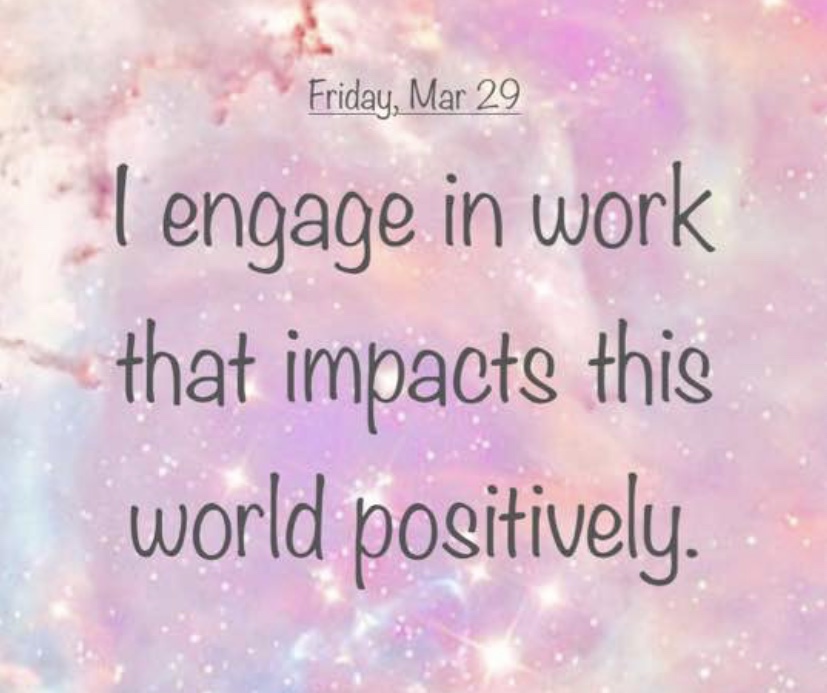
I spent the majority of Spring Break mulling over these conversations and how they apply to my “Why.” The following screenshot popped into my social media feed on Friday, and it spoke to me:

I have no idea who wrote it or what app it came off of so I can’t give credit to the author, but I thought to myself that those words are essentially my Why in a nutshell.

So here’s a draft (because there will be others) of my Why Statement.

To engage in work that impacts the world around me positively so that others can grow, learn, and honor one another.

What does the draft of your “Why” look like?

Two Worlds

There’s a particular time of year in which some teachers, definitely administrators, and others who work in a school begin thinking about next year, essentially having feet in two worlds for several months as one school year is coming to a close and another is beginning.

I gave up trying to use a typical planner long ago because my world doesn’t exist January to December. It exists July to July with some overlap during that month. I can’t set quarterly goals typical of an entrepreneur because there is so much ebb and flow to my year that I have distinct periods of time when goal-reaching can occur…

March through June, for me, is the most exhausting, rivaled only by October and February. I find myself having to be reactive to situations I swore were addressed in September more than once and that is upsetting. Questions run through my head quite often as I have to reflect on why something once again went south or simply didn’t run as smoothly as it should have or what I missed altogether. I find myself making plans for next school year, events and speakers, running on the assumption that a random date next March will magically draw a crowd this time instead of just the 20 people who show up to everything. I look through my ever growing to do list, having given up in November adding due dates because I learned two years ago that my priorities aren’t always seen as priorities for others (and sometimes others just don’t know they exist at all which is no one’s fault) and since there are a finite number of hours in the day, things I think are important often get pushed aside to be considered another day in favor of what others need or want to see happen in the “right now.”

I’m thinking of all the things that went well and all the things that are still needed. I’m thinking about things I’ll do differently, and how to get people to understand the thinking behind some of the decisions we make and the long term impact beyond just today. What do we need to purchase? What do we need to change? What do we arrange for that’s missing? What do we use? Why do we use it? How are we using the resources we have already? Or are we at all?

I’m thinking of how to address the constant requests for “more time” when there’s only 24 hours in the day and it’s not looking like there will be any hours added and I have nowhere to move the things that exist on plates…and no additional plates.

I’m thinking about leadership and boundaries and honoring people’s time and my own as well. I’m thinking about ways to empower teachers to take ownership when it feels like everything should be someone else’s task because there’s already so much to do.

I’m thinking about how to support families who are new and wanting to see a school that THEY envision in their heads…which doesn’t always match the actuality of what we do or who we serve. I’m thinking about the feedback I’ve gotten all year, the criticism and the praise and how they essentially cancel one another out–for every comment about what is wrong, there’s one mentioning something done right.

I’m thinking about how to support people and yet hold them accountable for information, tasks, and basic professional adulting. I’m thinking about what “professionalism” looks like in this business, because there is both an art and science to this work and there has to be room for both… There’s an element of professionalism in education that looks very different from other industries…and it should, but there’s also pieces that overlap and need to.

I’m thinking about how to get others on the same page and be able to share messages about the work we do and why we do what we do for the population we serve…it goes beyond “I wanted to be a teacher since I was four.” Why are we in this specific place working with this specific population of kids? We all had choices about where to land…why did we choose here?

I’m thinking about what I want for myself as I grow professionally. What organizations do I want to be involved with beyond my job? How do I want my service to others to be–or do I want to leave it open ended according to need, spreading myself among many? How do I put boundaries around my time when it comes to working in other capacities to ensure that my time is honored instead of assigned? What parts of my work do I want to grow? Delegate? Eliminate altogether?

And always back to that question…What’s my Why?

This is the time of year that the Why looms over every conversation, decision, and action I take. This is the time of year in which second-guessing is an everyday occurrence.

I’ve come to the realization that I can’t make everyone happy though. Someone will *always* be unhappy with something I’ve said or done or the impact a decision made had on them. What gets missed is that for most of us in an organization, we each exist in a tunnel of sorts, with all of us heading toward the same destination for the most part but each traveling in our own tunnel. Each tunnel is of different widths, and encompasses more information or less depending on the role we play and connects to others at variety of points, much like exits on a highway. Some are narrow with only a few exits, and those traveling within them can see a limited end, perhaps a particular project or result. Other tunnels are vast and those traveling within them see not only immediate needs but those in the long term as well as the impact that the organization can have beyond the confines of its walls. It’s these that often branch beyond the smaller exits, creating new tunnels that connect to others and who can still see the big picture, but also the greater impact. It’s these that understand the Why and have their feet in two worlds…sometimes more.

Professional Development

A school leader I’ve met a few times says that if you learn, it’s your own fault. He’s a pretty amazing guy, very charismatic, but also incredibly practical. He said once during a training that it’s the job of school leaders to train up people so that they grow out of their jobs. It’s not because he doesn’t believe in keeping good teachers, but the best educators are the ones who keep growing, and for some, that means growing into other positions, either within the school or beyond it.

I had the opportunity to go to another school in my district today and observe. It’s very different from the one I serve in, with a very different population and focus, having lots of very cool things going on, from a STEAM-focused class that integrated science and art and writing and discussion toward a large-scale project to practice for a musical performance using a variety of instruments to tell a story. I had some particular things to be on the lookout for, but I found myself looking at general practice in the building more than anything else.

I saw a school that takes great pride in the work they’re doing with kids. I saw teachers who are trying to do right by the kids they serve, providing them instruction that makes sense for where they are. I saw teachers and support staff who have followed a calling. None of the work they did with kids came off as being a chore–they were doing it because they love the kids and want to see them grow. Everyone I spoke with were respectful of the kids they serve, excited to be doing this work, and though they acknowledged the challenges they face, they were generally happy to be there.

I’ve felt incredibly critical of everything lately but I haven’t known quite what to do about those feelings. I’ve been critical of myself, wondering if I’m doing right by the people I serve, by our mission and vision, in any and all aspects of the role I play in our school, and imposter syndrome has won more days than I have. I’ve been critical of others, trying desperately to reframe frustration into curiosity, remembering that change takes time and that all of this is a marathon, not a sprint. I’ve been critical of the world we live in, with all the public shaming of teachers and the work we’re trying to do going on. When I try to talk about things, it comes off as complaining, which isn’t my intent. When I hold it all in, I just get angry.

But today, I got to observe somewhere else entirely and see what was going on in another school, with teachers who have challenges, who are tired, who teach differently than I would, who help kids create music and art and words and connections. I couldn’t be critical…what they do is valuable and they’re serving the kids they have, not the ones they wish they had. It’s very different from my own school just looking into classrooms and seeing the instructional practices in action. I’d be curious to talk to teachers in more depth about their practice…what they’re content with and what they wish for.

It was different…but it was very good. Sometimes professional development goes beyond the conference or the webinar. Sometimes it comes from watching other people do your job with the kids they serve differently than you would with the kids you serve. Sometimes it comes from talking to someone with challenges that are very different from yours, not to commiserate, but to see things a bit differently. Sometimes professional development is simply suspending judgment long enough to just notice things…what’s on the wall, in the bookcase, how kids are responding to text, how teachers are responding to kids, and how kids are responding to each other.

It was a good day. I learned some things and it’s all my fault. And I think I grew a bit.

Curiosity…gave the cat another reason to nap.

We are doing a book study. We’re using Onward by Elena Aguilar and the accompanying workbook. I bought it on Audible when we started and the downside to doing so is that you lose a part of the intentional reflection. It’s something about the feeling of the pages between your fingers and seeing the actual words on the page and the ability to go back and skim for information that makes for more meaningful reflection.

This month’s focus in the book is “Be a Learner.” It’s pretty timely because February is traditionally the month in which educators across the country are seriously considering whether or not being a barista would be a better career move than remaining in teaching. We are frustrated. We are angry. We are quick to snark. And we are once again, tired. Naps shortly after arriving home are the norm, and sometimes the couch = bed because we’re so drained. February is a reminder that yes, we still have miles to go before we sleep (in June…)

Aguilar asks the reader to consider his or her experiences through the lens of curiosity and makes a challenge, of sorts, to see coaching and colleague feedback as an opportunity to learn and grow. She posted this video on the website for the book and I thought it was a good tie-in:

http://www.onwardthebook.com/yes-even-you-need-a-coach/

This time of year, much of the feedback we get is viewed as criticism and because our own criticality is high, both about our practice AND about the behaviors we’re seeing in the kids we serve, we take offense, looking for all the ways our coaches, administrators, colleagues, parents, and kids are failing us…how WE are failing ourselves and our own expectations.

She also challenges the reader to revisit the idea of time management. For many of us, Sunday is the worst day of the week. We drag through the day, putting off planning and prepping, and tackling the most mundane tasks in order to further procrastinate doing the things we need to get done to ensure we’re ready for the upcoming week, practically as well as emotionally and mentally. No other profession really has this issue. Lots of people don’t look forward to going back to work on Monday, but I think that teachers during February dread it with a special level of apprehension. Some of this stems from the eternal search for more time in the day…it’s like the Holy Grail and impossible to find. Between planning and prepping, making copies, sending reminder emails and updates to families, as well as checking in with teammates, finding more time to do the rest of it seems overwhelming.

Sometimes it seems that we begin focusing on the wrong things this time of year. We focus on “they ought to know by now,” the behaviors that drive us nuts that we are pretty sure we’ve addressed eleventy-billion times a day since August, the eternal search for more time in the day, and all the ways we feel like we’re failing when we meet with our coach or team. Why not reframe these feelings in ways that are more productive and focus on learning from them?

Instead of “they ought to know by now,” why not ask the question “What have I missed–it’s evident they DON’T know, so how can I support their learning so they can know and apply it?

Instead of focusing on the behaviors that drive us nuts, why not remember that behavior sends a message and be curious about it. Why does Joey continue to make that noise when he works? Does he even know he does it? Why is Serena avoiding a particular type of work? What is Mia getting out of the snarky comments back when I ask her to do something? Why is Jeremy incapable of keeping his hands to himself in any situation? What is it that he’s trying to get by touching other kids and things? What is this behavior telling me?

Instead of listing all the things we have to get done, why not take a hard look at how our time IS being spent? Am I putting out fires when I should be letting someone else handle it? Am I allowing (and even encouraging) interruptions in my day without thinking? Am I tackling the things that need doing in an order that makes the most sense? Am I procrastinating? I find that I have to reassess my time particularly when I feel overwhelmed and determine where I am losing time so that I can refocus my priorities, reblock time, and reschedule my day so that the most important things still get done–it might not be in the timeframe I planned, but it can get done. I have to remember too that my priorities have to change because the needs of the people I serve change. I’m still very much learning how to do my job…it’s not static and that’s part of why I enjoy it.

Instead of focusing on feelings of failure, how can we take feedback and learn from it? What questions do I have that need clarification after I’ve had a chance to think? How can feedback help me grow in my practice? What IS my Why and if I’ve lost it, how can I find it again?

I really enjoyed this particular chapter–there are lots of other good nuggets in it, but these are the ones I really wanted to reflect upon. I get to lead a conversation with our staff tomorrow about it, and I thought it was pretty important that I take time to do my own reflection…much like I would think about a lesson before I planned it out.

Some food for thought before I close. What thoughts do you have on generalizations about a big idea? I loved sharing these with kids as we begin a new unit or as we’re working through one, coming back to them to see if what we said at the beginning was still true now that we’ve learned more about a concept or topic. It made for very rich discussion and a way to come back to a guidepost as we learned together. As I think about this particular time of year, I agree with Aguilar’s big idea of “learning.” The thing about generalizations is that they are true or applicable in multiple situations. So if the big idea for this month is “learning,” do you think that these generalizations work?

  1. Learning generates both additional learning and additional questions.
  2. Learning can be either positive or negative.
  3. Learning is necessary for growth.
  4. Learning occurs over time.
  5. Learning can take many forms.

How will you reframe your challenges this month to be more curious and see yourself as a learner? Are the generalizations I proposed above true for you?

Conference Season, Part Deux

February is when the rest of the annual conferences are scheduled. One of my favorite conferences happens in February, CCIRA.

CCIRA is a literacy organization a friend introduced me to years ago. Their conference is one of the largest in the country, and it often has big names in literacy education speaking either as keynotes or in smaller sessions. It’s a little like Comic Con for Language Arts teachers. This time, I ran (literally) into Gerry Brooks, saw Mark Overmeyer coming to breakfast, had Dr. Bob Seney sit in one of my sessions right up front, and though I missed Tina Boogren, I knew she was there–I felt it. (The self-care energy is great with that one…)

What I love most about it though is that so many of the speakers are local educators. These are the people doing the work in their classrooms every day with kids and they are willing to take two days out of their time with kids to come and share their own learnings with the rest of us.

I’ve presented at this conference twice. This year, they picked up both my proposed sessions and I felt incredibly nervous about them both, despite the fact that I’ve presented both more than once. I met with a friend to chat about how to become more of a dynamic presenter and I spent several hours tweaking both presentations so that they’d be just right for the audiences I’d have, which almost always include people with very little experience in teaching our tall poppies.

So many buildings use basal readers–those big classroom textbooks with a smattering of re-written and simplified stories and non-fiction pieces for students to read and answer questions about. Most programs have a small group timed schedule that looks like this:

Day 1: Teacher reads, vocabulary instruction, skill introduction

Day 2: Popcorn reading, vocabulary review, skill practice with text

Day 3: Partner reading, more vocabulary review, comprehension practice

Day 4: Independent reading, skill and comprehension practice

Day 5: Test, which is almost always a mixture of multiple choice, matching, vocabulary, and if you’re lucky, a short answer or two requiring information that’s right there in the text.

Then the next week they begin again with a new story or non-fiction piece.

Teachers work hard using a system like this to support their readers, providing really intentional instruction in both skills and content. And most basal programs aren’t all bad. For a typical learner or one requiring lots of repetition or specific supports, this type of learning situation can be a good thing, providing explicit instruction in specific skills. They do level the playing field, incorporating instructions for support and accommodation, but what’s provided for “enrichment” usually doesn’t follow gifted best practice. For a gifted learner though, this is a recipe for disaster and kills a love of reading fairly quickly.

One of the things I’ve learned in my years of teaching is that kids, particularly gifted ones, need to read genuine, original literature if they’re to learn how to comprehend text. They need to learn how to work their way through a complex sentence or paragraph, go back and reread a difficult piece of dialogue to figure out who the heck was actually speaking, and they need to learn to muddle through longwinded descriptions of paths lined with trees. The author had a purpose in including that part, after all. More importantly though, as readers, we want to connect with the pieces we read. When we choose books, we look at the first few pages, the cover, the back cover, read the recommendations of others, and then decide if we want to commit to it. We want to know the characters personally by the end of a story, and when reading non-fiction, we want to get our questions answered by the end of the piece, so we choose what we read intentionally. Kids don’t always get that choice, so it’s up to us to help create some connections for them. And that requires going beyond the basal text…

One of the sessions I presented was all about making connections to text. I used a short piece from a well-known author, a woman of color. I was introduced to it not in school, but in a conference session presented by a friend of mine who has far more years experience teaching literature than I. As our intimate group chatted about the piece, ideas began to spring into my head about how I could use this with kids, and how I’d like to see them respond to it.

He helped me create connections to the text by asking a few very deliberate questions. I was looking through the eyes of my students as I read, thinking of all the things beyond the words on the page that I saw in it.

That’s reading. That’s practicing comprehension. That’s exploring vocabulary and sentence structure.

That is the work of readers.

This time, this particular session went very well, and the energy in the room was high, people were engaged, and like when a lesson goes the way I picture it will, I moved on to my next session a little high on excitement.

The people in the room were probably excited to learn a new way to help their kids learn to read literature, but I suspect they left even more excited having had the opportunity to remember what it was to be a student and experience learning in a way that allowed them to remember what it felt like to think and make connections.

We don’t do that very often anymore as adults–we let the news tell us what we need to know, flip through stories on facebook or twitter, read professional books for specific purposes (to get that ONE kid to finally show what they know…) or learn new strategies to help us be more successful, or sometimes slip into a mindless read to downshift into a world of someone else’s making.

This week, I double dog dare you to read something for the sake of creating a connection. Let yourself explore the words, allowing them to roll around in your mouth and wonder why the author chose those words in particular to use to describe something. Allow yourself to step into the shoes of a character or person in a non-fiction piece and think about what their world is really like beyond this one snippet of text. Think about the possible connections that might exist to your own world, that of your kids, current events or past ones. And consider the author’s purpose in writing it…and for whom it was written. Bonus points if you chat with another person about what you are thinking…

There’s no fear that your tongue will stick to a metal pole in this challenge, but you might grow some dendrites and remember what it was to think for yourself with no fear of judgment…

One Key Word for Gifted Learners: Connection

This is a piece I wrote in October for CCIRA. The idea of connection ties together everything we do for our tall poppies, both in the classroom and outside of it.

CCIRAblog's avatarCCIRA Professional Development Blog

By Teresa Brown

“Differentiation” is a key word in the vocabulary of any teacher just out of their teaching program, and is one that we continue to use throughout our careers. We cultivate a variety of strategies over time to reach our typical and struggling learners, providing multiple levels of mentor texts, explicitly teaching and reteaching skills to analyze and understand literature and non-fiction, supporting our young writers with graphic organizers and patterns to help them get their voices down on paper in a way that reaches their target audience, and supporting them as they grow to into critical readers and writers.

But what about the gifted students we serve?  What tools do we have to support them in a way that helps them to grow as well?  How are their needs any different from those of a typical student?

Screen Shot 2018-10-09 at 6.18.29 AM Photo by Fischer Twins on Unsplash

Being gifted goes beyond…

View original post 958 more words