All posts by Tall Poppy Teaching

Unknown's avatar

About Tall Poppy Teaching

I choose to call my blog "Tall Poppy Teaching" because tall poppy syndrome describes a cultural phenomenon in which people who have achieved something beyond the typical are cut down, resented, or attacked. Tall poppies in a field are often cut off to ensure uniformity. The kids I serve fall under the "tall poppy" category and gifted education is often seen as elitist and unnecessary. But it is neither. I've chosen to work in a school that is designed for gifted and other out-of-the-box learners in the Rocky Mountain region, acting as a pseudo-admin in addition to doing a lot of other things that are being added to my job description daily. I get to innovate, problem-solve, and advocate for our tall poppies. When I'm not working, I enjoy spending time with my boyfriend and furs, experiencing wonderful food and drink in the shadow of a tall mountain, yoga, fly-fishing, and reading books about characters who can solve the world's problems in the span of a few hundred pages.

Plans and Goals

When I get to spend time with people who have experience far beyond mine in gifted education, people who truly understand why I do what I do, it’s both exhilarating and draining at the same time. (I slept for 10 hours last night…) I was in a room with mentors, teachers, scholars, and advocates. I realized that I am so very much at the beginning of this journey of advocacy and still have so much to learn.

I chose to work with the gifted population and immediately felt at home with them. Many of my friends and colleagues chose to teach where they do for perfectly good reasons too, and I honor that within them. The work we do, all of us, is so incredibly important and ALL of these kids matter. There is an educator advocate for every population of kids, with lots who overlap, and it’s in working together to support them all that everyone benefits.

When I get to be with people who understand these kids at an incredibly deep level, I feel at home too. I don’t feel like I have to fight or argue to get people to SEE these kids and talk them into understanding their quirks rather than dismissing them as lazy, stubborn, disrespectful. I know that they understand my giddiness when what my gut said turns out to be validated with data to support it. I know that they get it. They see the kids I describe. They were one of them.

A friend received a scholarship award at the CAEGTC – Colorado Academy of Educators for the Gifted, Talented, & Creative banquet yesterday. I’m so proud of her. She is one of a few that I seek out at trainings, ask for advice, trust with my frustrations. She works to make sure that the kids she serves are seen and supported by the other educators in her building.

I had my bucket filled by our keynote speaker, Jenny Hecht from Karuna Healing, LLC. She gets it. She’s real and what she shared touched exactly what I needed right then.
I spend a lot of time questioning how I can better serve these kids, be a better advocate for them, without getting stuck in the “drudgery zone” of the everyday minutia and tasks that don’t move the needle toward making a difference for these kids.

Last year, a friend pushed back on something I wanted to do, questioning my motivation. Her questions were valid ones, not with malicious intent, and while it hurt to hear that someone would think that my motivations were selfish, I could see how work I enjoy doing could be viewed that way. I thought about our discussion while I chatted with people at the banquet yesterday. I wondered if any of them had had a similar conversation–they’re now all very well known in the gifted community, with several spanning a variety of areas in education as a whole because of the work they’ve done.

I wish I could say that I have set plans and a roadmap for what I want to do in the gifted world. I feel sometimes like I’m using an outdated app that has me driving a Ford Focus on roads only intended for Jeeps with enormous tires and four wheel drive to get where I want to go. Luckily, I have people who have traveled this road already and can support me while I figure it out, making plans and setting goals for myself, both long and short term. Goals that will move me toward whatever it is I’m creating.

I hope you have people in your world to do the same for you.

Magic Word

There are certain words that strike us. Words that bring about feelings of happiness, sadness, frustration, anger. Trigger words. Words that remind us of who we once were…and remind us of who we hoped to be.

I have had a very long day and been on the brink of tears for some time. Hell, I’ve had a long month. Fine. A long school year and it’s only November. Part of me feels as though the last one never really ended and despite all the new beginnings and good things, there’s been no down time to be able to really start fresh despite two brand new planners, a multitude of productivity and inspirational podcasts, nightly meditations about knowing my worth, and revising my own rituals to make them better so that I feel as though the self-care that I know I need is really happening. But I have felt lost for a long time, as though somewhere I left a big piece of myself somewhere else…setting it in a box and tucking it away safely for later in favor of all the things that others felt were important or all the things that simply needed to be taken care of.

Tonight a friend uttered a magic word as he made a request of me that I haven’t thought about in a while, except in those infrequent passionate conversations with people who get it when frustration is winning and tears sting my eyes. I figured that others had forgotten or that they never saw it to begin with.

Advocacy.

Let me explain. I write a lot about my Why, which right now reads like this:

To engage in work that impacts the world around me positively so that others can grow, learn, and honor one another.

I’ve felt for a long time that my Why Statement was general, and that was fine, but there was something missing.

The days that I feel best about my work involve giving our kids opportunities to self-advocate or advocate for others, whether that’s talking with a teacher about modifying a project or activity, taking the lead on something that could make a difference, or speaking up about how to best support a peer. The days I go home happiest are the days I get to talk with parents and am trusted to support them in advocating for their kids and their needs, even if the conversation was difficult or complicated. The days I feel good about the work I do are those in which I get to share some of the best practices we’ve developed and implemented over time that benefits the kids we serve. The days I feel accomplished and fulfilled are the days that I get to share a bit of what these kids, these tall poppies, really need us to know and do on their behalf to make their lives better, their school experiences meaningful, and help them go off into the world and do good…whatever that might look like for them.

I get to do a lot of things in my current role and generally, I appreciate that I’ve been entrusted with all of those things–I wouldn’t have been asked if someone didn’t think I was capable. I use the word “get” intentionally, for the record, but the to-do list is ever-growing and all of the things are important in some way to the greater good. With all of those responsibilities though, something has to get set aside. I’ve felt all year that something was off–I was missing a piece of myself, not getting to the really important bits, and not often leaving school at the end of the day feeling like I’d done much in support of the things that really matter.

That piece that’s been missing is advocacy for these glorious gifted kids.

It’s why I choose to work where I do and want so much to help teachers SEE the kids they’re serving. Not the behaviors. Not the work that gets done too fast or too slow or not at all. But SEE WHO THE KIDS ARE.

It’s why I choose to present at conferences and spend hours of my own time creating what I hope will be a meaningful session to the people who choose to spend an hour with me, all the while hoping that they leave the room being able to look at one of their kids a bit differently when they go back into their classroom on Monday.

It’s why I revise wording in outreach emails meticulously, and ask lots of questions so that I understand better what people are in need of learning. Do they want a quick fix, or do they want to really learn about who these kids are and what they need?

It’s why when I talk with other educators I get so incredibly upset when they can’t find their way to seeing that gifted kids NEED people who are willing to go the extra mile and think outside the box and provide an education that is meaningful to them.

It’s why when one of our kids is hurting or struggling, it hurts me that much more–whatever pain they’re experiencing is so multi-faceted…and so many only see one facet of it, trying to insist it’s something simple.

It’s why I seek out others who get it–people who know what it is to not quite fit and who are able to see past the pieces of these kids that others see as faults and see the beauty of who they truly are.

It’s why I find it so hard to say no when there’s critical information that needs to be shared to better help people, everyone from parents to the guy who came to fix the cable to teachers to politicians, to understand who these amazing kids really are…truly see them.

Gifted is who they are, not what they produce and not what they do. Gifted kids need advocates. They need people to stand up on a soapbox and tell the world that they need for us to make changes to how we’re doing things to ensure that they all learn something every day, that they all grow, that they all know that they are SEEN.

Thanks for helping me see the thing that’s been missing, friend. Thanks for seeing me.

Coffeeshops and Chair Dancing

I stood in the warm sun for a few minutes (almost 70 degrees in November…gotta soak it in before Monday when it snows again) before hoisting my work bag out of the trunk with a grunt and slinging it over my shoulder, switching my handbag to my other arm for a bit of balance. The sage green (because most fishing-related things are green, beige, or blue) Fishpond messenger bag held my Mac, a smattering of files containing items that have existed on my digital and analog to-do lists for over a week, two pencil bags of random office supplies and cords, and good intentions for getting the work in the files finally taken care of. As I walked into the tiny coffeeshop which seats perhaps 20 altogether, I noted that biscuits and gravy were available until 11 and inhaled the familiar scent of roasted beans. I could work here a while before my meeting started.

I found a tiny table against the wall and pulled out my planner and phone with the intent to listen to a book while I worked, trying to find the best way to arrange things to accommodate the tin of biscuits and gravy (yes, because they were there and I can’t replicate them at home) and huge cobalt coffee mug while I began reflecting on the past week.

I must have looked ridiculous to others sitting nearby; a table of four young ladies in probably their early 20s glanced over more than once to watch me figure out the logistics of coffee, brunch, and journaling on a table meant for just coffee.

Most coffee shops have some sort of music playing low so that conversations don’t dominate the ambient noise. This one had an eclectic arrangement that made me grin a little. It was happy music–songs that brought memories of moments to mind. As I sipped my latte, scenes of Ben Stiller and Cameron Diaz flashed in my mind, and the four young ladies at the large table next to me began humming, then singing, then going full out show choir performance. It was absolutely adorable and completely made my morning. Others kept their exuberance under wraps, but I noticed that just about everyone at least hummed along a bit, chair dancing ever-so-slightly because you just kinda have to. It’s like an unwritten law.

One of the buzzwords in education right now is self-care. I have spent a fairly decent amount of time thinking about it, both for myself and for the teachers I work with and serve. I question often what more I could be doing to support others so that they get to care for themselves, making their lives a little easier, taking on tasks or figuring out workarounds to make processes simpler, both honoring and supporting their intensities when stress brings That Tone to the table. There was so little I could give over as a teacher–it was really all mine to own. The planning, the grading, the communication, the conversations. I had to own it all and I remember how that felt…it looks different now, but That Feeling is the same.

Simon Sinek says that leadership isn’t about being in charge. It’s about taking care of those in your charge. I think that sometimes, if we remember what it was like in the classroom with kids who are both glorious and utterly frustrating at the same time, we can get a little clarity and offer support in other ways. A quiet space to think or work. A chance to take a minute and sit outside in the sun. An opportunity to finish that damn email you started during recess or call home with a young one. A space heater when the heating guy took your blower away to fix it…and it’ll be a while before it comes back and it’s fixing to be a little cold. A soda of choice or a cup of tea delivered. A meeting that becomes an email. Popcorn or another treat slipped in among the papers in the mailbox. Taking a child who would benefit from a break with you to help you sort some things for a few minutes. The simplicity of letting someone know they’ve done a good job on a task that caused frustration. Our tall poppies aren’t always the children we serve. Sometimes they’re the people we serve with and they need care too.

They say the act of smiling brings about feelings of happiness even if you aren’t, making stress a bit smaller… Maybe this week, offer up a quick dance party during announcements to a song that brings people joy, makes them grin, or just invites a little chair dancing.

Relationship

We sometimes catch ourselves getting caught up in the day-to-day work of teaching: the anticipatory set that doubles as a pre-assessment, the mini-lesson and modeling, the gradual release to go off and do this work, reminders about the extension work that’s available, or the on-the-fly assignment that draws on a child’s area of interest and also meets a need for us. We greet kids at the door, keep them from getting themselves into trouble with the gift of proximity, non-verbal cues, and The Look from across the room that often fixes more than one potential issue because no one knows who The Look is actually for, but assumes it’s them.

We do all these things and after a while, it becomes rote, muscle memory taking over, the routines you taught are just as routine for you as they are for the kids.

In my current role, the routines that look so pretty on paper or in my head as I drive into work every day often get interrupted or never even started. Someone’s out sick (or may not make it through the day because one to many kids exhaled the ick into the air and not sleeping well let them catch it), the before-school care is late or doesn’t come in at all, an event needs to be set up or an important part of a first-thing-in-the-morning activity needs to be located, someone can’t make it in due to car trouble or traffic or weather, or I just flat forgot something that seemed to suddenly appear on my calendar (even if it had been there a while and I put it there myself…). When I was teaching in my own classroom, few of these things really impacted my day unless it was a teammate out or the fact that I forgot a field trip or classroom event. The ebb and flow of the day was generally the same and there was a sense of calm about it all.

“I will not embrace frantic,” a friend often says when things are not going according to the beautiful plan she had in her head. It’s hard not to embrace it some days, particularly when you want to wrestle it to the ground and strangle it altogether for messing up your day.

But there are moments that remind me that for all the routines that have become rote, for all the plans that explode upon arrival, there’s one thing that manages to weave itself into every day that we shouldn’t forget.

Relationship.

Every classroom management program on the planet talks about the importance of relationship with kids and their families. That’s how self-managing classroom communities get created. That’s what allows learning to happen every day even when there’s conflict. That’s what makes the dreaded phone call home about a problem in class have a reasonable, solution-focused outcome. Relationship with colleagues is just as important–when you have to ask a favor, want to give praise or kudos or support, or need to talk through something difficult. Creating good relationships with the people we serve and do this Big Work alongside make doing our job a little easier.

It’s more than just that though.

Relationship is what keeps kids coming back to your classroom because they know you have squishy dice, a full set of rulers or whiteboards, calligraphy pens and books for a project in another class, the grammar book they know they can find information in that you’ll lend them because you taught them long ago that you’re willing and they know to return things they borrow. It’s what leads them to your classroom for a pencil to take to class so they don’t get admonished for losing yet another one by a teacher down the hall.

It’s what gives a nurturing colleague an idea to share with an entire region of kids in support of some of their own.

Relationship is what sends messages to the littles who barely know who you are that you like hugs in the morning and love being read to when your kids are with the encore teacher. They watch and listen to your interactions with the kids who were once yours pretty carefully to decide how to handle you. When they see the way you talk to you and treat other kids, it helps them see that you are ok, not scary, and someone they can go to when they need a band-aid, help with writing (maybe math too), or just to talk to when they’re sad.

And the best thing, I think: relationship is what shows kids who are new to the school when you aren’t in the classroom anymore that you will always have their back, even when they make mistakes–doesn’t mean you won’t call them on it, but you’re there to help them grow and learn from it. It’s the message they get from older kids who’ve known you their whole lives that you’re looking out for their best interests and want to see them be successful beyond the classroom. Street cred matters.

Somehow that message gets down the hall to the little ones who ask to have lunch with you, just because, and read you page after page of the big Pokemon book with all the descriptions, truly worried about you because you admit you haven’t played Pokemon Go from anywhere beyond your couch at home in over a year (srsly, who doesn’t play it all the time if they are old enough to have a phone!?) and only have 74 Pokemon and you’ve had the app for three years.

And it’s why littles want to crawl into your chair with you to read or tell you about their hamster who passed away last week, and why they ask you to play line tag at 7am when the first cup of coffee isn’t even halfway consumed, and why they sing you happy birthday at the top of their six-year-old lungs…or 13-year-old lungs, complete with cracking voices and Jazz Hands in the middle of the hallway during a transition. And you tear up for both of them for different reasons.

The proverbial “they” say that teachers don’t teach for the money or the fame, and they’re right. We teach, even once we’re outside the classroom, because of the relationships we get to create with kids and their families, colleagues, and the community as a whole. Every one of us is an ambassador for our profession, and though we can’t hide the exhaustion we feel most days by October, we can still remind each other why we do this Big Work:

Teaching is the profession that makes all others possible.

The modeling we do of caring, compassionate, and healthy relationships with one another, with the kids we serve, and with our families is what will help these young people go off into the world and be good people who do their own Big Work.

Beware the Ides of October…

To engage in work that impacts the world around me positively so that others can grow, learn, and honor one another.

Several months ago I put words to my Why after many lengthy chats with friends and mentors. I’m realizing that it’s important to revisit it now and then because it’s pretty easy to forget when things get busy.

October is a good time, for the record. A very good time indeed.

October is the time of year when administrators and office staff start taking bets before the first bell rings on how many visits from children struggling to meet behavior expectations there will be when the barometer drops and the weather changes. It’s the time of year when teachers are balancing getting sick with taking a day off to catch up on grading or prep–is it possible to stay home to do both and still be productive? It’s the time of year when all the professional development conferences are scheduled to ensure that guest teachers remain employed until February when they’re needed again for the second round of PD conferences. It’s the time of year that the words “They’re dropping like flies!” requires clarification as to whether it’s referring to teachers or students, sickness or other things…

I requested the opportunity to work offsite last week to catch up on a few bigger projects that are best worked on with little interruption. I go home at night with best intentions, packing my bag with things I’ll need, thinking I’ll *totally* work on them when I get home, only to sit down and fall asleep on the couch, flanked by furs without jobs and something edible from a bag that probably isn’t good for me. There’s just no energy left in October. It’s as though it gets sucked out of me overnight between the 30th of September and 1st of October. Energy vampires are real, trust me.

I felt the need to revisit my Why this week in particular after looking back over the past couple of weeks to make sure I hadn’t missed something, revising task lists and project needs while I was working offsite, and coming across a quote in my planner that said,

“People lose their way when they lose their why.” ~Gail Hyatt

When I requested an offsite work day, it was out of sheer desperation–I’d lost my way completely. The task list grew longer by the minute, the requests more frequent and requiring more immediate addressing and cognitive power to problem solve, the nights later with event after event, and the time to get things done by deadlines shorter. I’ve never been great at setting boundaries or asking for what I need, but in looking at my Why, I could see the connections to it in all the things I was trying to fit in. That helped a bit to reframe the overwhelm I felt.

October is when some feel as though they’re getting into a groove with their work. I always felt that way in the classroom with my Tall Poppies. I knew my kids, knew where they were academically and such, knew where we were headed together to learn what was needed by the end of May, and had the ability and confidence to change lanes quickly and roll with things when I needed to. I haven’t felt that way about my current role at all in the last four years. Tasks get added and changed and removed, my role advancing and receding like the ocean against the sand. I never seem to know where I stand or which boss I answer to in the moment.

Taking a minute to sit with my Why has helped reframe it all though: To engage in work that impacts the world around me positively so that others can grow, learn, and honor one another.

My Why is a journey, not a destination; often it seems there is as many construction-related detours to navigate as there is real-life construction within the city limits. I need to remember that it’s ok when I need to request an offsite work day to help me move forward on the journey.

The reason we do this Big Work.

Ghosts

Before I came to teaching, I held lots of different jobs, and most had an air of “secretary” to them whether that was the title of the role or not. My mother was a secretary her entire life so it was a job that came pretty easily to me–I had a wonderful teacher from the time I expressed an interest in learning to write. She organized paperwork, typed letters, made phone calls, scheduled appointments, followed up on sales calls, created contracts, and basically did just about everything that her boss required of her to make his or her life easier at work. Often, she had several bosses at once: the business park property manager, the therapist whose office was across from her desk, the accountant, the lawyer, the optical shop owners, the guy who owned the cleaning company, my dad and his multiple iterations of his sales rep business…and others who came and went over the years.

The majority of the work I did prior to teaching involved some aspect of the things my mother spent her life doing. I typed contracts and took phone calls. I scheduled sales appointments and greeted customers. I handled paperwork, follow up with vendors, and took on projects that would make my bosses’ lives easier. When I moved into insurance sales, things got more complicated. I not only had to do all the things that I did as a secretary, but also handle all the sales of things you can’t touch that people don’t want to have to have. One of the words that came up weekly during our staff meeting, if not daily as my boss walked by my cube, was Productivity.

Right now, the ghosts of bosses past are haunting me and that word, Productivity, echos constantly. The one who told me that because I was single and without children of my own, it was my job to make sure that I was available to cover shifts when others had things come up–even if it meant canceling my own plans or appointments. The one who told me that personal time off was only in my employment contract because the law required it be there because I was technically a full-time employee–taking it was grounds for being fired if it wasn’t an emergency as defined by the company. The one who told me that if I didn’t complete everything that was handed me to do, my job was on the line. The one who reminded me daily that a pink slip was imminent if the goals set for me weren’t met. The one who noted that if I wasn’t giving my entire life to the work, I wasn’t truly dedicated to the success of the organization.

My Facebook memories, which began during my first year of teaching, remind me every day of these ghosts. The notation of 15-20 hour work days, either self-imposed in the hope of finally getting ahead or required because someone had to fall on the sword and take the late shift, in addition to all the early ones no one else signed up for, are many. The posts about overwhelm, mistakes, long discussions with myself in the hopes of figuring out how to make “work-life balance” actually happen seem to be a yearly event around this time. Memories of the exhaustion-fueled meltdowns after finally getting home at night, so tired that putting on pajamas was an effort and bread and butter was dinner because a microwave meal was just too much. People think that teachers don’t know what the kids go through all day, having to hold in all the emotions so that we don’t get into trouble, but we do–we often melt as soon as we’re in a safe space, too….and sometimes we lose it in the dairy department of the grocery store with the 5pm post-work crowd in between meetings and evening events. Productivity continued to be elusive.

We’ve been reading a book about how to manage your bosses as part of our professional development. It’s timely, really, as any role within a school doesn’t have just ONE boss–we have several, and for those of us with multiple hats to wear, sometimes there’s more than one boss for every hat worn. As I read this summer, I started naming the bosses I have and their expectations of me in the work I do–everything from the kids themselves, to their parents, to my colleagues, all the way up to people working at the state level. I made a spreadsheet, at the suggestion of one chapter in the book, of how I would track and demonstrate my progress on a variety of projects to essentially justify my paycheck and position. I made lists of ways I could reach out to each boss and tried to determine how to get a “meeting” in with them to check in. I tried to schedule the hell out of my day to ensure maximum productivity to ensure each bosses’ tasks get met. The one thing that the book doesn’t discuss is how to manage the ghosts of bosses past.

What do we do when the voice in your head is that of a ghost telling you that you are likely to be replaced or eliminated entirely if you can’t take care of <insert one-more-thing here>?

What do we do when the ghosts are so ingrained in our psyche that we hear ourselves saying them out loud when discussing the pile of things, both real and virtual, that need to get done on the left side of our desks?

What do we do when we buy a new planner in the hopes that the organizational support it is supposed to provide will help fix the overwhelm, helping us decide what’s most important–though we know that what we feel is most important isn’t what the ghosts are telling us is most important?

What do we do when new bosses take a cue from the ghosts and jump the queue and begin making requests, adding to the left-side-of-desk pile with the best of intentions but the expectation that you’ll take on yet another thing?

What do we do when new bosses seem to have spoken to the ghosts and suggest that we aren’t doing enough…nothing we do is enough, and our request for support, shared responsibility, or creative problem solving is effectively denied?

What do we do when the boundaries we try to set around our time and our priorities, based on our experiences with the ghosts of bosses past, are blown to smithereens before we can even put our handbag down? Or before we’ve even left the house? The ghosts bosses past remind us that unless we handle it right that second, we’ve lost their trust…

What do we do when the voice of a ghost wakes us up at 2am barking about all the things we failed to do the day before, the week before, the month before, the year before, threatening to demote or fire us or cut our pay because we put our need for sleep ahead of one-more-thing?

What do we do when we feel guilt over becoming a boss for someone else, making requests because it’s necessary or because delegation is the only option that is logical, but the ghosts remind us that doing so is tantamount to failure to do the job we’ve been hired to do?

The ghosts of bosses past don’t ever really leave us, no matter how we try to get them to go away. Some days their voices are louder than any of those that exist in real life, adding snide comments about our abilities and threatening pink slips, and some days they lie in wait for a moment of insecurity to show up in our dreams fueled by exhaustion and overwhelm and remind us of past mistakes, past lack of capacity, past lack of productivity, and past inability to simply make things happen when it’s demanded.

Sadly, I don’t have answers for what to do yet. (Perhaps that’s a follow up book to the one we’re reading now: “How to Manage Ghosts of Bosses Past.”) The reminders that we are hired to do a particular job are frequent, but not everyone can see what that job actually entails daily. And they don’t know about our ghosts and what they continue to whisper (or scream, in some cases) to us long after they’re gone, leaving us exhausted from fighting them all day and into the night.

Growth

I spend time intentionally each weekend in a “Mindset Meeting” with myself reflecting on the week and planning for the next, and at the end of each month, I spend a bit longer looking back over the month and documenting things to celebrate, like accomplishments, projects, self-care goals, and noting continued areas of growth and ways I might accomplish other goals I set for myself.

When I was in the classroom, which is starting to feel like an eternity ago if I’m honest, I remember offering kids the opportunity to do the same type of reflection as we worked together: What’d you learn today? What do you want to learn tomorrow? What’s something new that you learned about someone else? What are you curious about?

Sometimes their answers were off the wall or completely unrelated to anything (during a study of the middle ages, a student noted that he wanted to learn more about string theory…) and sometimes they were unfiltered and honest (“I didn’t learn anything new today.”) which lead me to do some serious reflection of my own. Most of the time though, their reflections related to what we were studying or working on at the time and were the beginnings of a reflective practice that learners ought to have the opportunity to develop, even at the tender age of eight.

So often, the first question a parent asks of a child when they get in the car is “What’d you do in school today?” which gets the standard “Nothing.” A few bloggers out in the world have suggested wonderful phrasing to not only get more out of a child but also give them a chance to really reflect on their day.

Who did you go out of your way to be nice to today? Who was nice to you? (A variation would be something about playing together depending on the age of the little.)

What is something that you found really easy today? Something difficult?

It’s important to focus on both sides of the learning experience and the social aspects of school too, I think–the good and the bad. For a lot of our Tall Poppies, they have the perception that everything has to be perfect, easy, and without conflict or discomfort. Some even feel that expressing feelings of anything negative somehow is a let down for their parents–like somehow they’re a disappointment if they have a tough day.

Others have been taught through how a conversation goes with their parent or even overhearing what adults say to one another about their own work that a negative response is expected. When kids are asked “Who bullied you today?” or “Did so and so bully you today?” Kids feel obligated to answer because the expectation is that someone or a specific child DID do something (even if they interacted very little and those interactions were neutral) unkind. “What’d you do in school today?” might garner a list of things the child hated doing: “We had to research using books (omg, so outdated!) and not the computer and I couldn’t get anything done because I HAVE to have a computer to research.” Kids know that mom wouldn’t ask if she didn’t already expect a particular answer, right? Kids want to give parents what they’re looking for even if it’s not completely accurate–not doing so leads to more interrogation. Their parents often had lousy experiences in school and so assume that their child will have that same experience.

It’s critical that adults are mindful of their own wording when asked, “How was your day?” When kids hear us say with a heavy sigh that our day was busy or that we were swamped or we’re feeling stressed, they will associate “work” with these responses, so “How was school?” must elicit a negative response, sometimes with tears for emphasis so that a connection to mom or dad can be made. Responding with more neutral or growth mindset-based wording is helpful; instead of “Oh, I was so busy and had a ton of useless meetings and got nothing done!” we might rephrase with “There wasn’t a lot of downtime today and I had to put off making progress on the project I’m working on which was disappointing. I’ll review my calendar in the morning and block out some time for that work tomorrow.”

This is an area of growth for me personally, for sure. Our conversations at home often begin with “How was your day, love?” and the litany of complaints and frustrations roll off my tongue and into my wine before I can catch them some nights…

Reframing during a conversation is important, but sometimes reframing in the moment is even more important. Earlier this month I found out that the proposals I submitted in the spring for a particular conference didn’t get picked up and I was pretty disappointed. As I worked through the more mundane pieces of a couple of other projects while I wallowed in my disappointment, I realized that those proposals not getting picked up would free me up to do a few other things I’m interested in. And that’s a good thing in the long run. Those other things will provide me opportunity to grow in other ways. Most of us, kids included, learn best by doing…and sometimes that doing is something new altogether which is both scary and exciting at the same time.

We have so many opportunities to grow during our lifetime. For some of us, our parents often worked in jobs to have a paycheck–many weren’t fulfilled beyond the twice a month paycheck they received for working a certain number of hours. Their growth, personally or professionally, was not a priority. As I was reflecting this morning on the past month, I realized that I began my professional life doing what I knew, what was easiest. That work afforded me time to study (because no one EVER came in and I got the work I was assigned done quickly.) As I moved from job to job, in time, I wanted to grow into other aspects of the business or other positions…or grow into another position somewhere else altogether. It was through reflection that I made decisions about what I wanted to do and how I wanted to grow. All of that has transferred into my personal life too–it’s not that my life isn’t good enough, there’s just more I want to experience.

How do you approach growth for yourself professionally? Do you wait until someone gives you an opportunity or do you see a need and offer to fill it? What about personally? What things challenge you? What brings you joy? We ought to be asking our kids these same questions, really…and modeling that type of thinking for them in our conversations with our own peers and family.

Common Agreements

I had the opportunity to provide a workshop at another school several hours drive from home this last week. I’d been giddy with happiness when the Director approached us to start with, and as we worked together to prepare a workshop that would meet the needs of her staff, my excitement grew. There’s something wonderful about that feeling of anticipation mixed with what-if-based fear and the happiness that you feel once it’s confirmed that what you had in your head was what they had in their heart.

A component of the workshop was designed around the idea of common agreements among staff. Mike Schmoker wrote a book called Focus some time ago, and in the time I’d devoured that version and we’d worked two years with it, another edition and a book for school leaders has been published. In all three books, he talks about what educational researchers like Robert Marzano and Rick Stiggins and others have learned works well. The beauty of the Schmoker books is that it takes all of that very dry research and puts it together in a way that describes the things that have the largest effect size and why they work. It’s a no-nonsense kind of book. Do these things; you will see improvement.

But all of that potential improvement hinges on one thing: Common Agreements. Those practices, routines, and expectations that everyone agrees to implement for the greater good, even if they aren’t everyone’s preferred way of doing things.

When we embarked on our book study of Schmoker’s original book years ago, it was fascinating to see how everyone’s educational philosophy came to the forefront of our discussions. Some were very much stuck in the middle to high school and into college mindset of “I assign-you do-I grade-there is no further discussion.” Others were more flexible in their comments, considering project and problem-based learning opportunities to be the way we should do things to allow for student choice, part of gifted best practice. And still others called on their own experiences in school and their own preferred way of learning, feeling that lecture and note taking using one particular model had to be the way in which we provided content to our students. And others felt strongly that everyone must be doing the same assignment, the same way, at the same time because then we could ensure that all children were experiencing the “consistency” that they felt we so lacked. And some felt strongly that we should consider a mixture of everyone’s ideas–there is a place for all of those things for a child while they’re learning, after all. Everyone agreed we needed to see growth in our students and that changes in our practice needed to occur, but common agreements were difficult to come by.

As the years have passed, we’ve determined that some of our common agreements need to simply be directives: We will use this resource in this way and everyone will do it….full stop. Those are compliance based and are honestly quite difficult when you take into consideration the artistry that teaching involves–when you can see the bigger picture, however, you can help a teacher to understand that he or she doesn’t have to lose the artistry to implement what’s being required. Other aspects of our work toward common agreements involved lead teachers and committees of teachers who gathered for a specific purpose–those with many years of experience among them who have watched pendulum swings that educational practices often go through or have practical knowledge of the impact a particular practice will have later on. We revisit common agreements every year it seems, particularly when new staff joins us, and it’s one of those pieces of our culture that is really critical–making sure that everyone is on the same page, understanding our goals and roadmap to get there. I won’t lie and say there isn’t pushback every year on some level, but often in retrospect after the initial conflict, it’s more questioning to understand than “I’m not gonna and you can’t make me.” Education is dynamic, not static, because the needs of the stakeholders change over time. For instance, eons ago we had no idea that tech addiction would be a thing, but now we definitely have to address it in how we handle it for our population of learners. We can’t go back to typewriters or further back to dictation necessarily, but need to figure out how to get kids the skills they’ll need while addressing potential addiction.

In working with someone else’s staff to begin this process, using our story as the framework for how it might go, has been interesting. The discussions with teachers who have a passion not only for teaching, but also for what THIS building does and who they serve have been wonderful. Watching body language and noting “thinking faces” vs. “confrontation faces” is definitely a necessary skill, and in a way that’s similar to teaching kids, being able to adjust and modify as you go is critical. The best part though, is seeing teachers get excited about doing this work, this BIG WORK, with one saying she’ll pull last year’s data so they can review it to see where their growth areas are, another saying she’ll put together what a portfolio might look like so the staff can talk about it, another offering to create a spreadsheet to use to collect data, and another hunting for possible writing rubrics for each level that are already out there or that some have been using that can be tweaked so that their staff is more aligned in their grading practice. Teachers want to grow and learn, and it was wonderful to see that some were ready to take action to do it.

While it’s great to have total buy-in when making a change, it’s rarely what happens. Change is scary. I read somewhere that you can’t wait for 100% to be on board with a decision to make a change. You simply get some who are ready to take action on board and the others will follow. It’s not easy, particularly when you do truly care about your staff and the kids you serve, and want to allow for all to have a voice in the decision. There comes a point though, that a Fierce Conversation might need to happen. We know that teachers care about kids and want what’s best for them, but more often than not, there’s fear behind a refusal to comply, not simply defiance. Working through that fear is what’s most important, even if common agreements are still a struggle.

This is Big Work I love. This brings me joy. This is work I want to continue to do more of because I think it’s important. It creates a sense of community among teachers and a shared vision for the work they’re doing with and for kids. And THAT is why we became teachers–not to do it alone.

But how are the kids?

When I went to that conference in Minnesota in June to present, our keynote speaker was an educator who had moved up through being a first year teacher, a master teacher, a coach, and into administration. She’s not one local to me, but rather well known up der in the cold, cold, Nort. She connected with all of us, even me as the foreigner, on a heart level–one of the first things she did was share her first few days of teaching. Like most of us, they were horrible, exhausting, confusing, frustrating, and utterly deflating. We’ve all felt it. We’ve all considered Trader Joe’s as an career option. We’ve all wondered if we were really cut out for this. The women I sat with were simply fantastic women–one teaching in Kuwait and considering moving back to MN to marry and begin work in more traditional schools, another couple with several years experience just looking to learn and grow–because we never stop doing either one.

The keynote speaker shared the story of her first few days, how deflated she was over how things had gone and how none of it was what she imagined–she ran out of plans before 2pm every day and went into “What the hell do I do now?” mode–because that’s what you do when you are just starting out. She cried about how the day was not how she imagined, and her work wasn’t how she envisioned it, and the connection to her co-workers wasn’t what she hoped…she was the newbie and everyone could tell. And she talked to us about the exhaustion…the utter exhaustion that was unlike nothing she’d ever experienced. The dragging her teacher bag home at night with all the best intentions of grading All. The. Things…and then falling asleep with them around her on the floor of her apartment. And she cried. But then her mother asked, “But how were the kids?” And she was able to reframe all of the frustration, sadness, disappointment, and this-is-not-what-I-signed-up-for-ness…because the kids were wonderful and amazing and beautiful and perfect. Joey was such a kind-hearted child. And Sarah was struggling something fierce but wanted to learn. And Amir was just learning English and was eager to learn both the language and the content and figure out his role socially with all these kids who couldn’t understand him that he couldn’t understand either. And all the others…their stories… The kids were amazing.

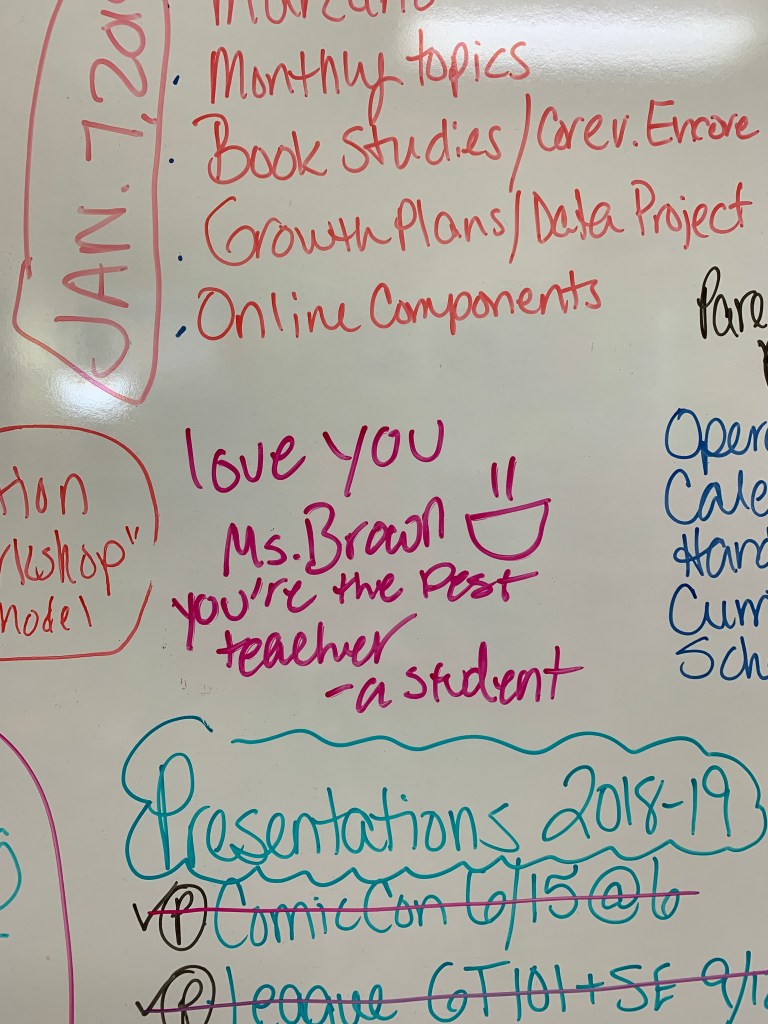
I spent last year creating systems and processes and trying out some things, learning to set boundaries and grow areas that I felt needed growing. And I loved the majority of it. The thing I lost among all that work, however, was the kids. I saw them, and got to work with them some, but it wasn’t the same as it had been in years past. And at the end of the year, a soon-to-be-graduate left me a note in the middle of all my plans on my whiteboard.

Love note from a kidlet toward the end of May 2019…
They know not the tears of joy I shed that afternoon when I found it.

As I listened to the keynote speaker, she noted that we do what she calls Big Work. This is Big Work, she said. Nothing about what we do in education is small–not for any of us, from the custodial staff to the Superintendent. It’s all Big Work. The prep, the planning, the compassion, the collaboration, the advocacy, the frustration, the learning. All of it is Big Work. And every bit of it is for the kids.

I have a lot of projects on my plate and I kind of prefer it hat way. It gives me a sense of autonomy and flexibility in my day that I wouldn’t get if all I did was discipline and attendance. I get to work with teachers through coaching and induction development, create workshops, presentations, and do conference planning, provide service in support of families, dabble in marketing, work to support those who can’t be with us just yet so that their hard work doesn’t get tabled, experience a new role as SAC, and work on other opportunities and my own professional growth as an educator. All of it is Big Work…every bit. But my purpose in doing is the same…the kids. The note left by my sweet kidlet, who will forever be mine, even when they are out in the world doing their own Big Work, reminded me of why I do this work at all.

So this school year, this year’s Big Work has a theme to it.

But How Are the Kids?

What’s your theme this year? What Big Work will you take on? And after the first few days of school, be sure to ask yourself…but how are the kids? Schedule time to reflect on that all year long…because we do all of this Big Work for them…

What Do You Want, Friend?

A friend posted on social media that she was talking with her BFF one night and the BFF, after listening a while to her concerns and worries, quietly said, “What do you want, friend?”

This question got me thinking. In education, we spend an awful lot of our time doing for others, making sure others have what they need and want. We make sure our students have what they need in terms of supplies, solid, well-planned lessons, and emotional and social support. We make time to chat with each one of them at some point, building relationships and trust so that our community of learners can run smoothly. We make sure their parents get what they need, everything from communication about upcoming projects, learning opportunities, behavior or areas of struggle to happy notes and phone calls home about something great their kid did that day or a shoulder to cry on when they’re frustrated with “Why can’t my kid just..” We’re not always successful, and some will feel we didn’t do enough. But we try. We make sure our teammates and co-workers have what they need–coverage for duties so they can make copies or call a parent or have a break, a shoulder to lean on or cry on when things get tough. Here too, some will say we didn’t do enough to make their jobs easier or make them feel appreciated.

We work so hard, and often they get the short end of the stick, to make sure our families get what they need and want too–dinner made, laundry done, bedtime stories read, cuddles and chats and quality time together being “just us.” A friend mentioned that her kids wondered during the school year when “t-shirt mommy” would be back. Pretty sure her heart broke. Mine did. I doubt the kids were being nasty about it, rather simply wondering when she’d get to take off her educator hat and put her mommy hat back on. We all do it–every educator I know has a really hard time switching those roles, even those of us who aren’t parents struggle with it.

But we rarely ask ourselves what we want.

I’ve been asking myself what I want for my life for well over a year. It used to be simple. I wanted to be a teacher. Done. Except, as I grew into that role, what I wanted changed. I wanted to improve in this area or that, or take on this role or work with that committee or organization. Gradually, I wanted to have a larger impact beyond the classroom…which led to the role I’m in now and the presentation opportunities I’ve taken. I was talking to a student last spring and my job description came up in conversation. I noted that I got to write my own, really, because my role hadn’t ever really been defined beyond some basic things. He thought that was pretty cool–not a lot of adults get to do that, settling quietly into a description created for them instead.

There have been more days than I’d like to admit where all I wanted was to go back into the classroom, into a familiar space that the kids and I created together, do the things I knew I was good at and the things I could do without thinking that led to praise instead of fierce conversations that made my heart and head hurt. All those things had, over time, come quite naturally…when to give The Look, for example, and when to stand next to the child who is friends with everyone and can’t, for the life of them, stay quiet…when to celebrate a lesson gone well and when to bail on one that is going not at all the way the movie of it you made in your head last night did. I look back and now those are the easy things…the familiar things…the comfortable things.

Growth and change are hard and often quite scary. In gifted education, we talk a lot about universal themes or “big ideas” and generalizations and use them to help kids make connections between ideas and concepts. We share them with kids when we start units of instruction to give them a foundation to begin the work of learning. In looking up generalizations for another big idea for a project I’m working on, I found these for the universal theme of “change” and thought they applied quite nicely:

  • Change is inevitable
  • Change can be either positive or negative
  • Change is generates additional change
  • Change is necessary for growth
  • Change can be evolutionary or revolutionary

I think my friend’s BFF is incredibly wise. In asking ourselves when we feel uncomfortable “What do you want, friend?” we can acknowledge that we’ve grown a bit and started the process of change. We get to make choices in our lives about what we want and who we want to become. We get to decide the kind of educator or business owner or parent or friend we want to be. We get to write our own job descriptions for each of these things–how cool is that?

So friend, what is it you want? Think on it. Roll it around in your head a while and then on paper and eventually, on your tongue. Say it out loud, more than once, and create something that illustrates what you want so you don’t forget. Remember, it can change, of course, but it’s good to have a first draft. 🙂